Tror inte på den hypotesen men testa gärna!
Tror snarare på strömdistorsion från motorn då det är typisk tredjeton som sticker iväg till ganska höga nivåer i övre mellanregister. Le/R är inte direkt hög men heller inte låg, ca dubbelt med sb15/17nbac.
se t ex:
viewtopic.php?f=3&t=73462&p=2265356&hilit=Induktans#p2265356viewtopic.php?f=10&t=71241&p=2142554&hilit=klippel#p2142554Klippelmannen skrev:Då Klippel har bra material, lånar jag några bilder som jag tycker ger en bra inblick och förståelse. Bild nedan visar vanligt förekommande orsaker till distorsion och inom vilket område de normalt verkar inom.
Kms(x)=Styvhet i upphängning, olinärjäritet vid utslag
Bl(x)=Kraft i motor, olinärjäritet vid utslag
L(x)=Induktans, olinärjäritet vid utslag
L(i)=Induktans, olinärjäritet beroende av ström

Edit, KII kanske reducerar distorsionen i elementen med adaptiva FIR-filter enligt t ex denna metod:
https://lup.lub.lu.se/luur/download?fun ... Id=9198124A FIR-filter was adapted using the NLMS algorithm. The filter was adapted on the 1–3 kHz band-passed white noise. The waveform distortion, Fourier spectrum, magnitude response and THD ratio was compared for the filtered and unfiltered speaker output. Compared to the unfiltered signal, a clear reduction in harmonic distortion was observed in the target range. Both the 1250 Hz filtered signal and the 2500 Hz filtered signal exhibit a 6 dB attenuation for the second harmonic and 10dB attenuation for the third harmonic. From this it is concluded that a static FIR-filter can reduce the non-linear distortion within the range where it is most efficient.
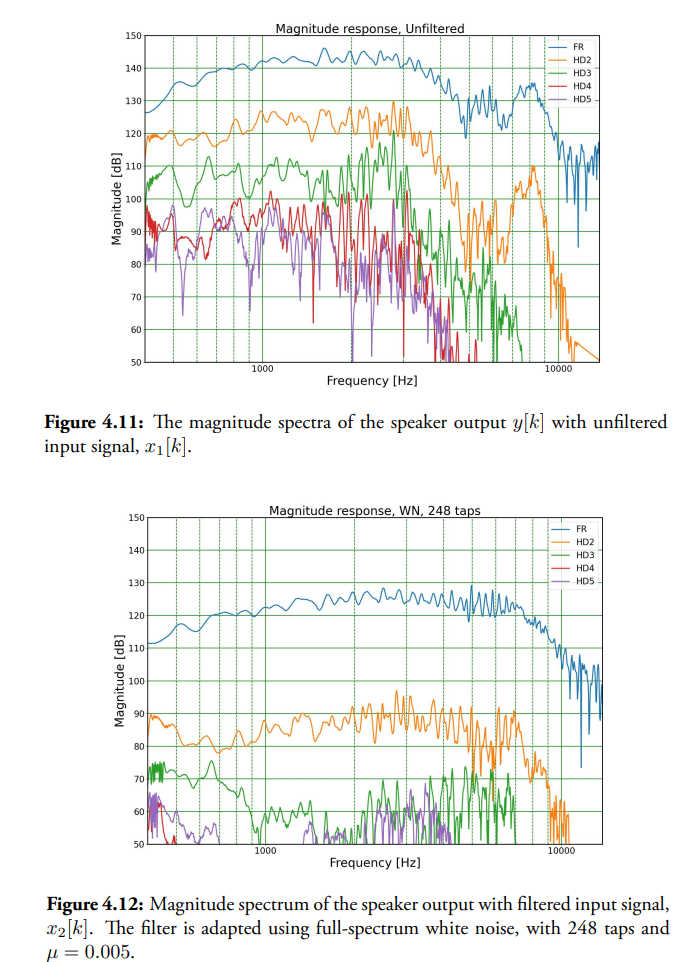
- FIR-Distorsionssänkning.png (476.61 KiB) Visad 241 gånger
Borde vara nästa steg i utvecklingen för aktiva högtalare efter ekvalisering med dagens billiga DSP i ASICS eller små FPGA om det är stora volymer, eller att någon gör något likande Camilla DSP och kör på RPI.
Using a digital filter to reduce distortion can improve both sound quality and efficiency in the speaker. With fewer distortions, the speaker doesn’t have to work as hard to reproduce a clean signal. That can reduce stress on the speaker driver and help extend the lifespan of the speaker. The filter is implemented as an FIR filter, which is a relatively simple algorithm with low computational cost. A more advanced non-linear approach would definitely require much more processing power, which in turn uses more energy. The FIR filter is suitable for real-time use without needing much hardware performance. Lastly, since the solution is digital, no hardware changes are needed. That helps reduce material usage and electronic waste. The same filter can also be reused in similar setups, making it more scalable and sustainable.



 behöver hitta en bättre balans mellan OCD och prokrastinering.
 ) så bör man notera att ljudtrycksnivån i diagrammen ovan skiljer sig mycket påtagligt mellan mätningarna och att det finns kryptiska formuleringar angående ljudtrycksnivån även i avsnitt 5.2.
