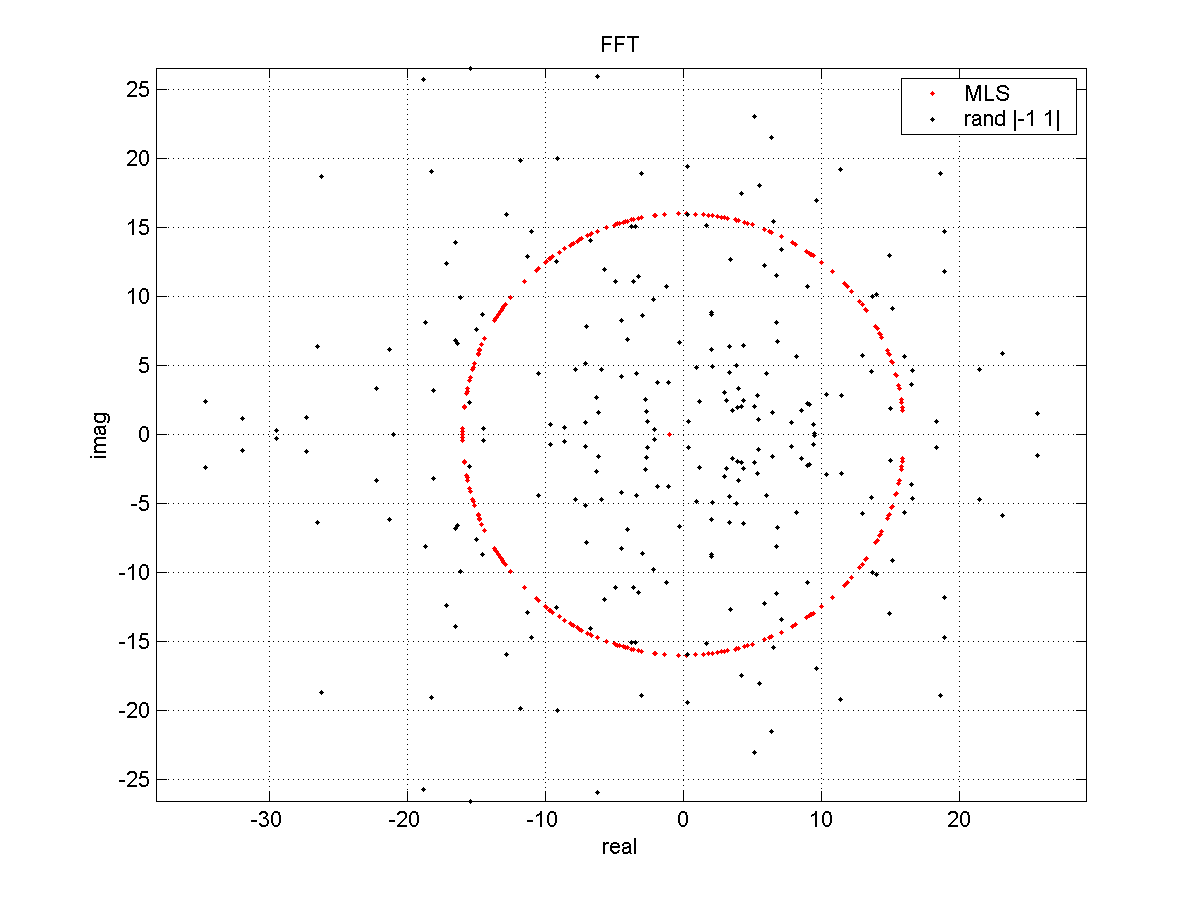
Varför knäcker icke lijära system MLS:en
jo:
MLS measurement errors come about when there are nonlinearities (the tutorial explains how, for a perfectly linear, time-invarient system, MLS measures your system impulse response). in a 1995 letter to the AES, some guy named Matthew Wright, had the insight to explain why these spurious and randomly delayed spikes were getting added to the measured impulse response.
If the system is modeled as a Volterra series (which is a pretty general way to model a nonlinear, non-memoryless system) you will get some cross-product terms that look like:
output y[n] = (linear terms like h[i]*x[n-i])
+ (nonlinear terms like someCoef*x[n-i]*x[n-i-j])
Now, those nonlinear cross-products can be manipulated a little:
x[n-i]*x[n-i-j] = (-1)^a[n-i] * (-1)^a[n-i-j]
= (-1)^(a[n-i] + a[n-i-j])
= (-1)^(a[n-i] XOR a[n-i-j])
= (-1)^a[n-i-k]
= x[n-i-k]
That means the nonlinear cross-product term ( someCoef*x[n-i]*x[n-i-j] ) is gonna look just like the input sequence but delayed by some wild value, k+i, and scaled by someCoef. So the measured impulse response will have an impulse delayed by k+i and scaled by someCoef.
That is where you can get problems in the impulse response and problems in the frequency response. Now, since this behavior is deterministic and repeatable (even though it looks like a random delay), you can repeat the measurement and average until the cows come home (or the cliche of your choice), and this problem will not go away. There are techniques for dealing with it (like try different MLSs based on different primitive polynomials and median filtering) but averaging the response using the same MLS won't help.
Källa:
http://www.dspguru.com/info/tutor/mls.htm
Volterra är jag vän med så det där kan jag nästan vara med på.
På samma sida så kan vi se vad akf:en är för en MLS:
- Kod: Markera allt
                 { 1         for n = 0, N-1, 2(N-1), ...
   Rx[n] = X^2 * {
                 { -1/(N-1)  for other n


 av lilltroll » 2007-12-03 02:02