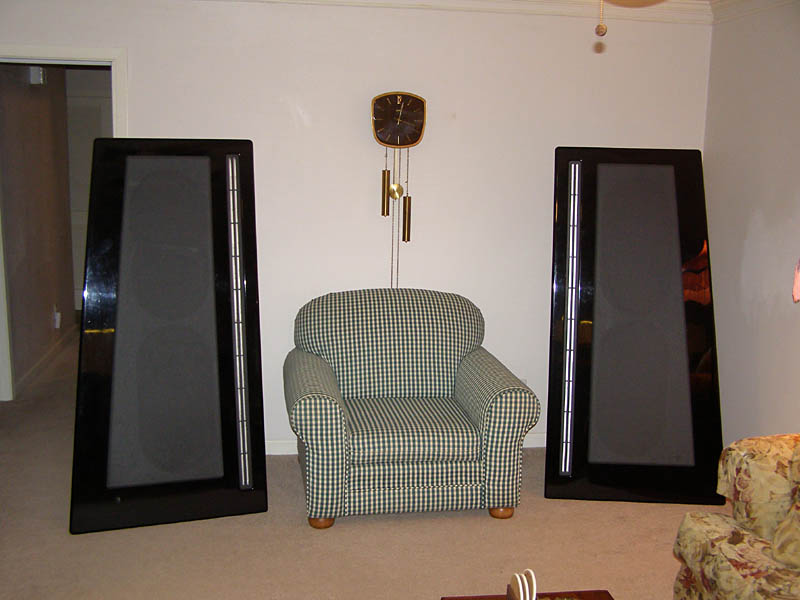
Moderator: Redaktörer
schmutziger skrev:Intressant att se att guru inte är med bland produkterna på sjofn:s hemsida längre...
Undra vad som hänt?
celef skrev: men enligt omdömmen så spelar högtalaren fint ändå, så baffelmåtten kanske är tillräckliga för vad dom vill åstadkomma, men även elementen är ju annorlunda

phon skrev:Ragnwald skrev:Vad är det för diskantelement?
Ett Vifa med en egen waveguide tror jag.
Ton skrev:Fjonkalicious skrev:Jävligt ful låda enligt mig.
Ja, det tycker jag oxå. Men fruarna gillar den tydligen o så låter den helt fantastiskt. Allt enligt texten ovan
paa skrev:phon skrev:Ton skrev: Borde det inte gå att skaka fram ett par i Sverige?
Det är enkelt.
En standard HiFiKit-låda. En bas och en diskant. Bygg ihop. Färdig.
Smart, att ingen tänkt på det tidigare?
celef skrev:men vad kan vara anledningen till skapandet av denna högtalaren, vad är det som har hänt, har sjöfn ställt krav på guru om en mer hemmaanpassad högtalare och fått nobben, sjöfn har då blivit sura och börjat gapa å skrika för att sedan kavlat upp skjortarmarna för att skapa sig något eget?
nilsviktor skrev:Vi noterar att det spekuleras om vårt förhållande med Sjöfn. Det kan vara värt att notera att vi inte haft samarbete med dem sedan hösten 2008. De hade oss med på sin hemsida längre än så, men det var inget vi kunde göra något åt.
Jacro skrev:Hello Everyone,
I am the designer of 'the clue' loudspeaker.
I noticed that there appeared to be some interest and I would be glad to discuss the clue or answer any questions that anyone might have.
I alway enjoy reading your forum, albeit with the help of Google translate.
I hope that posting in English is acceptable.
Best regards,
- James
Nej. Vi tyckte olika bara.screen skrev:nilsviktor skrev:Vi noterar att det spekuleras om vårt förhållande med Sjöfn. Det kan vara värt att notera att vi inte haft samarbete med dem sedan hösten 2008. De hade oss med på sin hemsida längre än så, men det var inget vi kunde göra något åt.
Kan det vara värt att notera varför också?
paa skrev:Hi Jacro!
Please tell us about your history with loudspeakers.
Jacro skrev:My involvement in music reproduction goes back to childhood, but professionally it started in 1973 ...
...
Snell: Type One (concept and proof of concept prototypes)
KarlXII skrev:Impressive resume there, James. Jeez.![]()
Again, Welcome to faktiskt.se.
Any chance we will see these speakers over here?
paa skrev:Jacro skrev:My involvement in music reproduction goes back to childhood, but professionally it started in 1973 ...
...
Snell: Type One (concept and proof of concept prototypes)
Thanks for the resume.
Did you come up with the concept of the Snell Type One?
What is your comment to that design today? Could that floor bound tweeter solve any of todays reproduction problems, or has evolution found better ways by now?
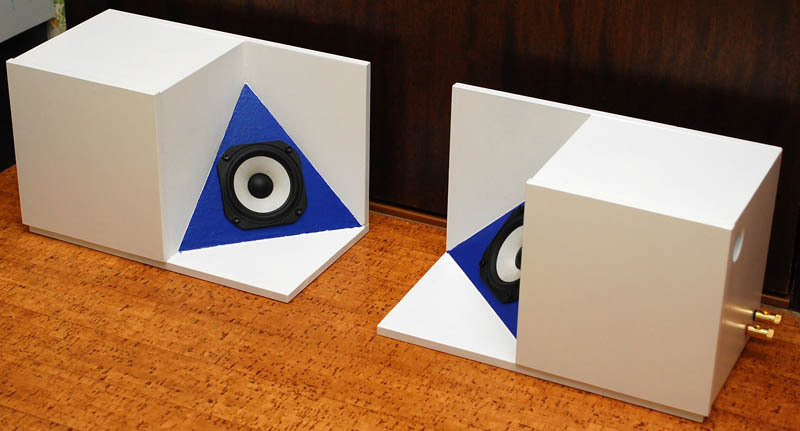
By the way, this is my attempt at full range floor support, a mini speaker built just for fun, inspired by Stig Carlssons prototypes and patents:
http://user.faktiskt.io/paa/minione_8.jpg
I also believe Stig Carlsson was somewhat inspired by the Type One at that time.
Jacro skrev:Carver Corporation:
The Carver Amazing Loudspeaker
(Planar magnetic line source/Dipole bass 12”x 4)
James Croft
Jacro skrev:[Thank you for the Carlsson pic! I hadn't seen that particular model.
...
..., and the production Type One, was that the image is too low... similar to sitting up in the balcony and looking down at the orchestra. But, it was remarkably uncolored and transparent.
Yes, the concepts still have much validity today and about 12 years ago, I built prototypes of some of my next generation thinking on the idea, of which I hope to get back to in time.
With all the DIY work that the groups in this forum do, I'm sure it would be a fun project for many here to try. The patent is public domain, so have fun!
All the best,
- James
celef skrev:välkommen jacro, kul att ha dig här, berätta gärna mer om högtalarna, är det verkligen parts-express-lådor?
jacro welcome, good to have you here, tell me more about the speakers, it's really parts-express-boxes?
BB skrev:Jacro skrev:Carver Corporation:
The Carver Amazing Loudspeaker
(Planar magnetic line source/Dipole bass 12”x 4)
James Croft
Hi James,
Cool to see that you have been working with line source systems.
Maybe we can have a chat over a beer next time I go to US..?
Best,
//BB
paa skrev:Jacro skrev:[Thank you for the Carlsson pic! I hadn't seen that particular model.
...
..., and the production Type One, was that the image is too low... similar to sitting up in the balcony and looking down at the orchestra. But, it was remarkably uncolored and transparent.
Yes, the concepts still have much validity today and about 12 years ago, I built prototypes of some of my next generation thinking on the idea, of which I hope to get back to in time.
With all the DIY work that the groups in this forum do, I'm sure it would be a fun project for many here to try. The patent is public domain, so have fun!
All the best,
- James
James,
With my small speaker the sound stage can at best be quite a bit higher than one would expect, but then sometimes not.
Do you see a possibility to raise the heigth of the sound stage from loudspeakers whith the drivers placed so close to the floor?
Here is an in-depth look into the design of the never finished Carlsson Three Way speaker:
http://www.faktiskt.se/modules.php?name ... c&p=502903
Jacro skrev:with the woofer still dominating the on axis response up to about 11 kHz wherein above that frequency, the dispersion driver starts to take
RogerJoensson skrev:Jacro skrev:with the woofer still dominating the on axis response up to about 11 kHz wherein above that frequency, the dispersion driver starts to take
So widely centered around (or mainly below?) 11 KHz you have two drivers several inches apart outputting equal levels? How have you solved the vertical dispersion, without getting deep cancellations only slightly above and below height center? -Or is this a design feature?
Jacro skrev:The way this approach of enhanced power response can be made to work successfully without interference is that the outputs of the two drivers are tailored in a unique manner such that the through the overlap region, the dispersion driver contributes more off-axis energy than on-axis energy, and the full-range driver contributes more on-axis energy and less off-axis energy. The amounts that each contributes to the on or off-axis energy varies with frequency, but at any given frequency, and axis, they are not providing equal energy, so the interference is minimized and good response is maintained above and below the listening axis.
paa skrev:James, would it be possible to push this concept with a full range driver and a filler tweeter to ever larger sizes, do you think?
RogerJoensson skrev:Jacro skrev:The way this approach of enhanced power response can be made to work successfully without interference is that the outputs of the two drivers are tailored in a unique manner such that the through the overlap region, the dispersion driver contributes more off-axis energy than on-axis energy, and the full-range driver contributes more on-axis energy and less off-axis energy. The amounts that each contributes to the on or off-axis energy varies with frequency, but at any given frequency, and axis, they are not providing equal energy, so the interference is minimized and good response is maintained above and below the listening axis.
So, in short. -The smooth/tailored power response is to heal the off-axis cancellation of the direct radiated/unreflected sound (due distance between drivers)?
m_persson79 skrev:It would be very interesting to listen to theese speakers.
Jacro, are they by any chance available in Denmark?
celef skrev:tack james för ett utförligt svar, jag är väldigt nyfiken på spridningstekniken i diskanten, jag likt många andra sliter hårt för att få ihop denna del i våra hembyggda högtalare, flacka delningsfilter och inte för stora element samt att försöka rikta huvudloben på sådant sätt att man minskar dips i vistelsezonen i rummet är min lösning hitills. vet du om stereophile eller soundstage kommer testa 'the clue', det vore väldigt intressant att se mätningar på dom
translate by google:
thanks james for a detailed answer, I'm very curious as to spread the technology in the treble, I like many others work hard to get together this part of our home-built speakers, flat crossover and not for major elements and to try to target the main beam in such a way as to reduces the dips in the occupied zone in the room is my solution so far. do you know about Stereophile or Soundstage will test 'the clue', it would be very interesting to see measurements on them
I'm very curious about the technique with the tweeter/treble dispersion, I like many others fight hard to get this thing together in our diy speakers, low order filters and not too large drivers, and trying to aim the main lobe to minimize dips in the place we dwell, is my solution so far.
paa skrev:James, I'll try to make an alternative translation of parts of that text, originally written by celef, where Google Translations was a bit off:I'm very curious about the technique with the tweeter/treble dispersion, I like many others fight hard to get this thing together in our diy speakers, low order filters and not too large drivers, and trying to aim the main lobe to minimize dips in the place we dwell, is my solution so far.
avr7000 skrev:Very nice to have you here!
Welcome!
Stefan
Jacro skrev:Audionics of Oregon:
TL-30
M33
Snell: Type One (concept and proof of concept prototypes)
Fulton (FMI) J-Modular Premiere Subwoofer and Supertweeter
Speakerlab Delta-i Hybrid
Satterberg MW2 mid-woofer for the Rogers LS3/5a
Carver Corporation:
The Carver Amazing Loudspeaker
(Planar magnetic line source/Dipole bass 12”x 4)
Carver/Toshiba Surround Sound Television Systems
JBL/Philips Projection TV Sound Systems
Dipole Surround Patent licensed to Lucasfilm/THX
Dahlquist DQ40, DQ30, DQ16, DQ6
American Technology Corp: (Now LRAD Corporation)
Hypersonic Sound (Hyper directional, Ultrasonic-to-Audio Parametric loudspeakers)
LRAD Long Range Acoustic Device (beam formed 1.5 kilometer communications)
Stratified Field; constant directivity electrostatic loudspeakers
NeoPlanar; planar magnetic transducers
The Clue
I have about 30 or 40 patents in the field of audio, mostly loudspeakers, power amplification and signal processing and continue to do consulting for many in the industry such as SJÖFN HiFI, Atlantic Technology, Magnepan and Wisdom Audio.
Glebster skrev:Jacro skrev:Audionics of Oregon:
TL-30
M33
Snell: Type One (concept and proof of concept prototypes)
Fulton (FMI) J-Modular Premiere Subwoofer and Supertweeter
Speakerlab Delta-i Hybrid
Satterberg MW2 mid-woofer for the Rogers LS3/5a
Carver Corporation:
The Carver Amazing Loudspeaker
(Planar magnetic line source/Dipole bass 12”x 4)
Carver/Toshiba Surround Sound Television Systems
JBL/Philips Projection TV Sound Systems
Dipole Surround Patent licensed to Lucasfilm/THX
Dahlquist DQ40, DQ30, DQ16, DQ6
American Technology Corp: (Now LRAD Corporation)
Hypersonic Sound (Hyper directional, Ultrasonic-to-Audio Parametric loudspeakers)
LRAD Long Range Acoustic Device (beam formed 1.5 kilometer communications)
Stratified Field; constant directivity electrostatic loudspeakers
NeoPlanar; planar magnetic transducers
The Clue
I have about 30 or 40 patents in the field of audio, mostly loudspeakers, power amplification and signal processing and continue to do consulting for many in the industry such as SJÖFN HiFI, Atlantic Technology, Magnepan and Wisdom Audio.
Respect, welcome to faktiskt.se!
celef skrev:translate by google![]()
thanks for the post james! concerning the low frequency alignment and boundary gain, can you elaborate on the mutual coupling, I do not think I've read about the effect before.
and thanks for the translation paa
paa skrev:James,
How would you comment on the horn community, with their compression drivers and horns that are designed more for low coloration and/or controlled directivity, than for maximum sensitivity and output. E.g. LeCleach, Kugelwellen, Tractix and Gedlees waveguides?
I believe there is quite a following in the US west coast and thus also Oregon for such things?
Do you see any advantages with any or all of those, compared to normal hifi-drivers for hifi and home theatre?
Nattlorden skrev:I've begun to wonder if it isn't just the waveguide but the entire speaker that should be machined into some bumpy blob thing to achieve desired radiation patterns...
Jacro skrev:celef skrev:...
...
Jacro skrev:LeCleach and Geddes have set good starting points in the formulations for the basic waveguide, but there are next generation architectures that are being developed to address the remaining device and systems issues. - James
Naqref skrev:Nattlorden skrev:I've begun to wonder if it isn't just the waveguide but the entire speaker that should be machined into some bumpy blob thing to achieve desired radiation patterns...
Like Genelec?

celef skrev:Jacro skrev:celef skrev:...
...
thank you for the post, i need to re-read it a few times. i have always thought about the loudspeaker as a mono-source, then interacting with the room or parts of the room, the interaction in a stereo setup is all new to me, i sure would have liked to discuss this in swedish
Nattlorden skrev:Welcome Jacro.
If you're able to manage it with through the translator - do make a footer which tells of your commercial involvement - it's a forum rule to have it like that.
Jacro skrev:I believe I have installed the footer information properly.
paa skrev:Jacro skrev:LeCleach and Geddes have set good starting points in the formulations for the basic waveguide, but there are next generation architectures that are being developed to address the remaining device and systems issues. - James
Could you point to one or two from that next generation?
And would you consider the DXT lens one of those, or how would you categorize that design?
Have you tried or seen other ways to fight HOM than the foam plug that Geddes has patented?
patjoh skrev:Interesting to have you here James, good reading. Checked out your store to http://www.definitive.com/ and it looks great.
Among all the brands you sell, what is your personal favourite speakers and amplifiers? (if you are not allowed to build them yourself)
paa skrev:James, would you think the HOM reduction foam also works as an acoustic lens that further smothes the dispersion whithin the desired coverage angle?
Jacro skrev:celef skrev:Jacro skrev:celef skrev:...
...
thank you for the post, i need to re-read it a few times. i have always thought about the loudspeaker as a mono-source, then interacting with the room or parts of the room, the interaction in a stereo setup is all new to me, i sure would have liked to discuss this in swedish
Celef,
I'm sorry that I can't deliver the information in Swedish. Maybe someone in the forum can help us with translations.
I think it is important in two-channel loudspeaker design to always consider both loudspeakers to be an integrated system.
In fact, one must consider the pair of loudspeakers, the environment/room, and the listener all as an integrated, inter-dependent system. The loudspeakers are coupled locally (mutual coupling) and also coupled globally (listener and boundaries).
(In a perfect world, the program source and method of recording would be included, but not in today's discussion.)
Mono-source evaluation of a loudspeaker is certainly useful, but it is only the starting point, not a complete characterization.
There are more issues than I can cover in this post, but, as one example, even the interference and resulting frequency response ripple due to cross-talk of the two channels at the listener's head must be considered when balancing the loudspeaker 'system', and this can only be observed when both loudspeakers operating at the same time, and interaction at the listener's body, is considered.
With two-channel reproduction, there is far greater complexity of all the interactive effects, but also more possibilities to improve, not only the spatial aspects, but also the tonal effects.
Then, of course, there is another set of issues relative to loudspeaker design for more than two channels...
Cheers,
- James
celef skrev:Jacro skrev:celef skrev:Jacro skrev:celef skrev:...
...
thank you for the post, i need to re-read it a few times. i have always thought about the loudspeaker as a mono-source, then interacting with the room or parts of the room, the interaction in a stereo setup is all new to me, i sure would have liked to discuss this in swedish
Celef,
I'm sorry that I can't deliver the information in Swedish. Maybe someone in the forum can help us with translations.
I think it is important in two-channel loudspeaker design to always consider both loudspeakers to be an integrated system.
In fact, one must consider the pair of loudspeakers, the environment/room, and the listener all as an integrated, inter-dependent system. The loudspeakers are coupled locally (mutual coupling) and also coupled globally (listener and boundaries).
(In a perfect world, the program source and method of recording would be included, but not in today's discussion.)
Mono-source evaluation of a loudspeaker is certainly useful, but it is only the starting point, not a complete characterization.
There are more issues than I can cover in this post, but, as one example, even the interference and resulting frequency response ripple due to cross-talk of the two channels at the listener's head must be considered when balancing the loudspeaker 'system', and this can only be observed when both loudspeakers operating at the same time, and interaction at the listener's body, is considered.
With two-channel reproduction, there is far greater complexity of all the interactive effects, but also more possibilities to improve, not only the spatial aspects, but also the tonal effects.
Then, of course, there is another set of issues relative to loudspeaker design for more than two channels...
Cheers,
- James
how is this done, if i look at it at different angles i get different results for each angle!? how important is this "compensation" for the average listener? do we all have different sensitivities for errors in this regards?
Jacro skrev:Celef,
I've put your questions below with answers after...
HOW IS THIS DONE?
There are a number of techniques.
One way is to simply calculate the differential in arrival distance/timing between the left and right channel to one ear. The half-wavelength (and each odd half wavelength) frequency the length differential corresponds to determines the cancellation or dip frequencies from which one can plot the ripple in the response.
Another way is to measure the differential error with a dummy head and in-ear microphones.
Another step is to compare the sound with and without a crosstalk cancelation device, using the crosstalk-cancelled mode as a reference for tonal balance.
Upon establishing the error, it is not necessary to correct all of the resulting measurable ripple. Instead, an gentle spectral correction, on a ½ to 1/3-octave basis, tends to be adequate for this type of error in that the first octave of error has a dip and peak that are a half octave apart. Above the first octave of onset, the comb filtering of the response is closely spaced and has high enough density that it doesn’t require further correction beyond the first octave, or so, of error.
The correction is a delicate one, in that if implemented inappropriately, it can create coloration in the mid-band.
As usual, this is an over simplification, and more is required to deal with the issue effectively, but hopefully this gives you the general idea.
IF I LOOK AT IT AT DIFFERENT ANGLES I GET DIFFERENT RESULTS FOR EACH ANGLE?
Yes, you are correct. The effect is different at each different listening angle.
That is one of the reasons that one must define the listening angle in relation to the loudspeaker pair very precisely.
Most loudspeaker companies only provide general positioning recommendations, hoping to satisfy a wide variety of different placement preferences of a large number of customers. Necessary for high unit volume products.
As an example of an alternative approach, with ( the clue ), we recommend a very limited use model, with precise placement, and listening angle requirements.
While this is not practical for everyone, due to the restricted use model, it allows us to better optimize the performance of the loudspeaker pair in a way that wouldn’t be possible if we recommended generalized placement.
HOW IMPORTANT IS THIS "COMPENSATION" FOR THE AVERAGE LISTENER?
I’m not sure what you mean by the ‘average listener.’
In terms of amplitude errors related to crosstalk cancellation, they tend to fall in the frequency range that the ear is most sensitive, and are also above just noticeable detection thresholds for amplitude errors, so most any listener with healthy hearing, will detect the difference.
But, your question is valid, in that even though most can discern the difference, will it be important to them?
I would expect discerning listeners to find each change of a similar magnitude to this one to be important, but I guess you would have to decide that one for yourself.
DO WE ALL HAVE DIFFERENT SENSITIVITIES FOR ERRORS IN THIS REGARD?
Interesting question.
I find that each listener comes to a listening session with a personal set of system attributes that they tend to prioritize and focus on in their listening experience and judgment.
BUT, I also find that often in a casual, uncontrolled listening session, listeners will often miss subtle system errors, but if I put that same person in a controlled, blind listening situation, I can almost always teach them to recognize the sonic error, such that after the training, they can then notice the same error in the general listening session.
Again, in the cases of crosstalk cancellation amplitude errors, they appear in the portion of the midrange that the ear is most sensitive to so they will tend to be audible to most listeners.
I hope this all makes sense.
All the best,
- James
celef skrev:Jacro skrev:Celef,
I've put your questions below with answers after...
HOW IS THIS DONE?
There are a number of techniques.
One way is to simply calculate the differential in arrival distance/timing between the left and right channel to one ear. The half-wavelength (and each odd half wavelength) frequency the length differential corresponds to determines the cancellation or dip frequencies from which one can plot the ripple in the response.
Another way is to measure the differential error with a dummy head and in-ear microphones.
Another step is to compare the sound with and without a crosstalk cancelation device, using the crosstalk-cancelled mode as a reference for tonal balance.
Upon establishing the error, it is not necessary to correct all of the resulting measurable ripple. Instead, an gentle spectral correction, on a ½ to 1/3-octave basis, tends to be adequate for this type of error in that the first octave of error has a dip and peak that are a half octave apart. Above the first octave of onset, the comb filtering of the response is closely spaced and has high enough density that it doesn’t require further correction beyond the first octave, or so, of error.
The correction is a delicate one, in that if implemented inappropriately, it can create coloration in the mid-band.
As usual, this is an over simplification, and more is required to deal with the issue effectively, but hopefully this gives you the general idea.
i'm not sure if i understand this, but i sounds close to recent topics about the "bbc-dip" and "fundamental flaw in stereo" we have had at this forum, i couldn't figure out then how this correction should look like, and how to achieve a frequency response that changed dramatically att smal offaxis anglesIF I LOOK AT IT AT DIFFERENT ANGLES I GET DIFFERENT RESULTS FOR EACH ANGLE?
Yes, you are correct. The effect is different at each different listening angle.
That is one of the reasons that one must define the listening angle in relation to the loudspeaker pair very precisely.
Most loudspeaker companies only provide general positioning recommendations, hoping to satisfy a wide variety of different placement preferences of a large number of customers. Necessary for high unit volume products.
As an example of an alternative approach, with ( the clue ), we recommend a very limited use model, with precise placement, and listening angle requirements.
While this is not practical for everyone, due to the restricted use model, it allows us to better optimize the performance of the loudspeaker pair in a way that wouldn’t be possible if we recommended generalized placement.
this is very interesting, how much of the room should be treated as part of the loudspeaker and when starts the room to be just the room? for my own speakers i sometimes use a simple model by roy allison to compensate for boundary gain, even though it calculates this in a simplistic way the compensation often sounds overcompensatedHOW IMPORTANT IS THIS "COMPENSATION" FOR THE AVERAGE LISTENER?
I’m not sure what you mean by the ‘average listener.’
In terms of amplitude errors related to crosstalk cancellation, they tend to fall in the frequency range that the ear is most sensitive, and are also above just noticeable detection thresholds for amplitude errors, so most any listener with healthy hearing, will detect the difference.
But, your question is valid, in that even though most can discern the difference, will it be important to them?
I would expect discerning listeners to find each change of a similar magnitude to this one to be important, but I guess you would have to decide that one for yourself.
DO WE ALL HAVE DIFFERENT SENSITIVITIES FOR ERRORS IN THIS REGARD?
Interesting question.
I find that each listener comes to a listening session with a personal set of system attributes that they tend to prioritize and focus on in their listening experience and judgment.
BUT, I also find that often in a casual, uncontrolled listening session, listeners will often miss subtle system errors, but if I put that same person in a controlled, blind listening situation, I can almost always teach them to recognize the sonic error, such that after the training, they can then notice the same error in the general listening session.
Again, in the cases of crosstalk cancellation amplitude errors, they appear in the portion of the midrange that the ear is most sensitive to so they will tend to be audible to most listeners.
I hope this all makes sense.
All the best,
- James
when looking at measurements of varios loudspeakers at sources like stereophile or soundstage there is hard to detect if they have been compensated for any errors, or at least i have not find any, is this due to the measurement technic they are using or is this compensation rare?
Jacro skrev:Answer to question #1:
I think that the BBC, or “Gundree”, dip is invoked to address audible coloration and inadvertently addresses the crosstalk cancellation errors. If one doesn’t analyze the source of the problem, but instead attempts to correct what is experienced as a tonal error, then one might apply a BBC type dip as a partial fix and hear a sonic preference in the result.
But, if one shapes the response correction to more closely follow the shape of the crosstalk error (not simply a dip), the tonal correction will sound more “life-like”. The BBC dip takes away the “peak” portion of the error, and softens the coloration, but also takes a bit of the “aliveness” out of the midrange.
All of this is fairly subtle, but significant in the totality of the sonic presentation.
All the best,
- James
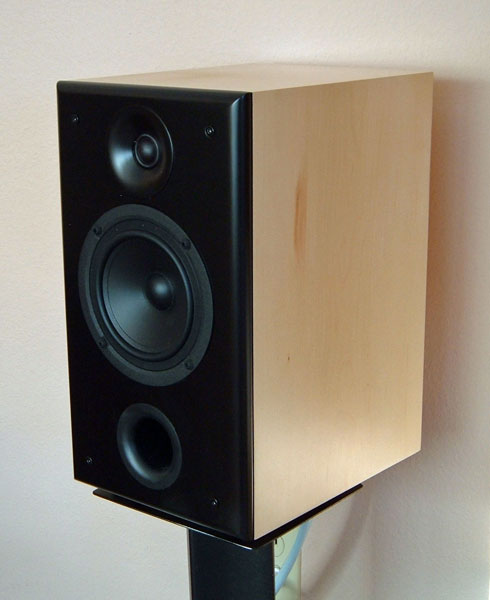
paa skrev:Anyway, here is previous discussion about the BBC dip:
http://www.faktiskt.se/modules.php?name ... &p=1064224
13.I've heard mention of 'the BBC dip' or 'the Gundry dip'. What does that mean?
There is much myth, folklore and misunderstanding about this subject.
The 'BBC dip' is (was) a shallow shelf-down in the acoustic output of some BBC-designed speaker system of the 1960s-1980s in the 1kHz to 4kHz region. The LS3/5a does not have this effect, neither in the 15 ohm nor 11 ohm, both of which are in fact slightly lifted in that region.
According to Harbeth's founder, who worked at the BBC during the time that this psychoacoustic effect was being explored, the primary benefit this little dip gave was in masking of defects in the early plastic cone drive units available in the 1960's. A spin-off benefit was that it appeared to move the sound stage backwards away from the studio manager who was sitting rather closer to the speakers in the cramped control room than he would ideally wish for. (See also Designer's Notebook Chapter 7). The depth of this depression was set by 'over-equalisation' in the crossover by about 3dB or so, which is an extreme amount for general home listening. We have never applied this selective dip but have taken care to carefully contour the response right across the frequency spectrum for a correctly balanced sound. Although as numbers, 1kHz and 4kHz sound almost adjacent in an audio spectrum of 20Hz to 20kHz, the way we perceive energy changes at 1kHz or 4kHz has a very different psychoacoustic effect: lifting the 1kHz region adds presence (this is used to good effect in the LS3/5a) to the sound, but the 4kHz region adds 'bite' - a cutting incisiveness which if over-done is very unpleasant and irritating.
You can explore this effect for yourselves by routing your audio signal through a graphic equaliser and applying a mild cut in the approx. 1kHz to 4kHz region and a gradual return to flat either side of that.
http://www.harbeth.co.uk/faq/index.php#13
paa skrev:Jacro skrev:Answer to question #1:
I think that the BBC, or “Gundry”, dip is invoked to address audible coloration and inadvertently addresses the crosstalk cancellation errors. If one doesn’t analyze the source of the problem, but instead attempts to correct what is experienced as a tonal error, then one might apply a BBC type dip as a partial fix and hear a sonic preference in the result.
But, if one shapes the response correction to more closely follow the shape of the crosstalk error (not simply a dip), the tonal correction will sound more “life-like”. The BBC dip takes away the “peak” portion of the error, and softens the coloration, but also takes a bit of the “aliveness” out of the midrange.
All of this is fairly subtle, but significant in the totality of the sonic presentation.
All the best,
- James
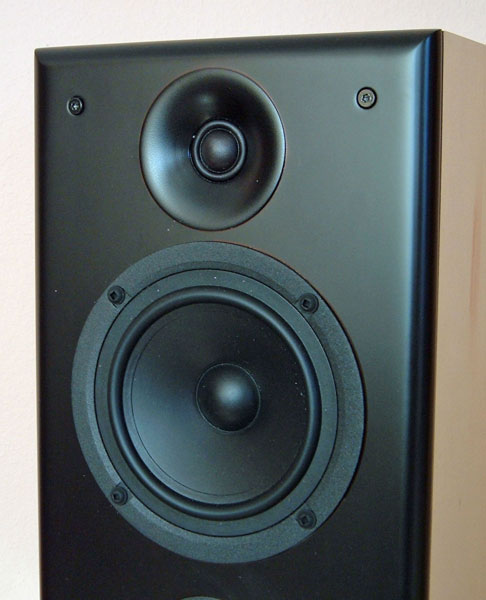
Interesting, especially the answer to #2 about your upcoming paper.
Anyway, here is previous discussion about the BBC dip:
http://www.faktiskt.se/modules.php?name ... &p=1064224
DanNorman skrev:Detta är alltså den raka motsatsen till pip (och guru qm10)?
Ingvar hade problem att hitta en tillräckligt högspridande diskant till pip, medan här väljer man att stoppa den i en waveguide. Intressant.
Objektivisten skrev:Hi James, welcome to the forum, what do You think is the secret about tubes and that they almost always sounding more pleasant and true to the ears? And do we really need all that watts, low powered amps seems to gain in transparent sound, may be construction simplicity or cost effectiveness? Why do I think carbon sounds more real than metal as a conductor? Any clue?
Jacro skrev: . . . . . .
Good audio is predominately a systems design approach, not an individual component selection approach. The components have to be appropriate within a standard deviation, but beyond that, it is all based on the impedance interfacing of the system.
Some designers operate from a systems approach, and some try to use all the most expensive components and hope for the best result.
Whether one has an unlimited budget or is designing for lowest cost, the systems approach will provide a better result and will tend to be less wasteful. But, it takes longer and requires more careful assessment.
Cheers,
- James
celef skrev:james,
thanks for your post, i need some time to think it throu. i have much to askbut one thing comes to mind; this might be against your policy but, what do you think about technologies like www.embracingsound.com
best regards
Kraniet skrev:Im a little bit more interested in the waveguide. I see you use a very small WG, so small that some people (like geedle) dont even call it a waveguide.
However I think reasonably sized WGs are more interesting and also would have more relevance in home-audio (as its more "design-driven").
Ive been looking at JBL* and what they call "elliptical oblate spheroidal waveguide" and by the looks of it it seem to be only 5x8cm or something like that. Thats very small when it comes to waveguides but they (JBL) seem happy with the directivity control, or matching, they get.
Looking at the site you linked to, small waveguides seem rare.
Do you fell that the WG have to be big to be effective? If one assumes a 2kHz crossover, is a size like JBL WG enough or is it just for show?
The DXT-lens is a diffraction lens and maybe not a true WG, but it is very effective att directivity control down to 2Khz. But being a diffraction-device there should be alot of HOM being created. Seeing the "rave" that this lens have got (like in the speakers from Acoustic Energy) it would seem that HOMs arent that bad?
In what way are you using the WG in your speaker and isnt it very short and of a "simple" profile to be effective as a WG? (no disrespect intended of course)
Heres the link to JBLs Linear Spatial Reference Studio Monitor System
*http://www.jblpro.com/catalog/general/Product.aspx?PId=26&MId=5
paa skrev:James,
Maybe you have a comment to Professor Edgar Choueiris work also?
http://www.princeton.edu/3D3A/
Kraniet skrev:seems limited to one person listening though. he speaks of it being viable for TV but I cant see how it would work in a normal living room with 4-6 people getting the full experience.
paa skrev:Jacro skrev:I have been working on new waveguide topologies that are based on an elliptical variation of the Oblate Spheroid.
- James
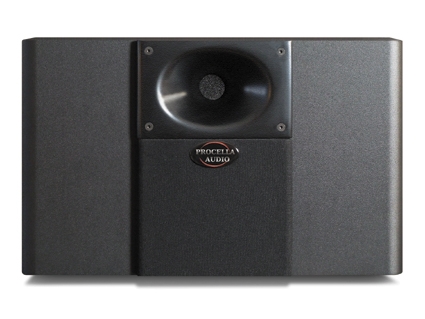
Seems like Procella has gone towards that direction too (and it's smaller than it looks in the picture):
Objektivisten skrev:Hi James, welcome to the forum, what do You think is the secret about tubes and that they almost always sounding more pleasant and true to the ears? And do we really need all that watts, low powered amps seems to gain in transparent sound, may be construction simplicity or cost effectiveness?
Laila skrev:Jacro skrev: . . . . . .
Good audio is predominately a systems design approach, not an individual component selection approach. The components have to be appropriate within a standard deviation, but beyond that, it is all based on the impedance interfacing of the system.
Some designers operate from a systems approach, and some try to use all the most expensive components and hope for the best result.
Whether one has an unlimited budget or is designing for lowest cost, the systems approach will provide a better result and will tend to be less wasteful. But, it takes longer and requires more careful assessment.
Cheers,
- James
James, welcome to the forum !
Like poetry in my ears (eyes) . . . . wonderful words.
Jacro skrev:
If there is further interest, I’ll try to follow up soon with a bit more information on the topic, including a few small signal issues with power amplifiers.
Jacro skrev:I originally interrupted your discussion here just to answer a few loudspeaker questions, and I don’t want to hi-jack your forum, so let me know if I am inappropriately dominating your discussions.
Stereotypen skrev:Hi, and Welcome Jacro!![]()
Very interesting ta read about your study of amplifiers/loudspeakers!
I am interested to hear what you think about Siegfried Linkwitz approach to loudspeaker design, dynamic dipoles.
I myself have found them to solve a great deal of the problems in the speaker/room area in my listening room. The uniform powerresponse may be part of the answer here i guess.
What are your experiences or oppinions regarding this?
Jacro skrev:...While I feel the half-space, boundary-coupled approach is the more universally consistent way to achieve the best effect,-
...
James
paa skrev:Jacro skrev:...While I feel the half-space, boundary-coupled approach is the more universally consistent way to achieve the best effect,-
...
James
You really sound like the Carlsson-followers here. Have you studied Stig Carlssons loudspeakers to any extent?
Kraniet skrev:Peter Steindl on this forum seem to draw on all those speakermakers (and some others im sure) in his "Egg"-speaker http://www.bremen.se/main/HT12.0/HT12.0.html
He speaks of his background and a little about the theories behind his speakers in this thread http://www.faktiskt.se/modules.php?name ... ic&t=16989
One claim being true 3D-sound with just 3 speakers. Its all very interesting, although its a bold claim.
Kraniet skrev:Ive been thinking in terms of wall-close speakers but its not all that easy. The shallow, flat box arent always that easy to position along the wall with the wall-sockets and what have you. So its either relatively small boxes hung on the wall or more conventional florstanders made for a close placement against the wall.
Kraniet skrev:Older Carlsson-speakers suffer alot by the fact that they are spreading the sound everywhere. Makes it all very diffuse and an artificial "soundstage". I call it painting with a wide (to wide) brush. The later madels work better but need a substantial dampening on the wall to not get that diffuse soundstage.
I get the same feeling with dipoles. But i guess some well placed damping and diffusion can work miracels with a dipole.
paa skrev:James, when you try to get a rectangular box like The Clue as coupled as possible to the wall, how much absorption would you prefer behind it? What size and thickness would you consider minimum and optimum?
Objektivisten skrev:Hi James, welcome to the forum, what do You think is the secret about tubes and that they almost always sounding more pleasant and true to the ears? And do we really need all that watts, low powered amps seems to gain in transparent sound, may be construction simplicity or cost effectiveness? Why do I think carbon sounds more real than metal as a conductor? Any clue?
Jacro skrev:Objektivisten skrev:Hi James, welcome to the forum, what do You think is the secret about tubes and that they almost always sounding more pleasant and true to the ears? And do we really need all that watts, low powered amps seems to gain in transparent sound, may be construction simplicity or cost effectiveness? Why do I think carbon sounds more real than metal as a conductor? Any clue?
Objektivisten,
I was just curious... I have not seen any comment or feedback from you on the answers I provided so far to your questions.
It is a rather complex topic, so I thought I should check to see if my starting answers were useful for you, such that you would like me to continue, or not?
Best regards,
- James
Nattlorden skrev:Jacro - almost no thread here ends on the same note as they begin, so that's completely natural.And feel free to comment/contribute in other threads than this one - I think I speak for everyone here when I say we're delighted to have yet another professional designer on the forum.
It's interesting when you all agree and equally so when you don't....
Jacro skrev:
To achieve this, I believe the loudspeaker should either be operated as a boundary coupled half-space device, or as an omni or full range dipole well out into the room.
Jacro skrev: The 2-speaker version of the use-model concept seems to be very much the same as the Harold Beveridge line source electrostatic from the 1970's, wherein Mr. Beveridge boundary coupled his loudspeakers to the side-walls, about 1/3 of the distance along the side-wall, facing each other. They were linesource, and electrostic, but the general sound field presentation seems the same.
http://www.bevaudio.com/
http://bevaudio.com/technical_details.html
The perceived sound field from this type of presentation is quite impressive, spacious and deep, and fun, but some other aspects are questionable.Also, it is difficult to find the correct room for them, that has the optimum length to width ratio.
Jacro skrev:[s a minimum I recommend 75mm thick acoustic foam that is arranged on the wall, inward from the right loudspeaker (going towards the left loudspeaker), starting at the inside corner of the cabinet that is closest to the wall, and also starting at the bottom edge of the cabinet.
The panel should be about 60 x 60cm, extending about 25cm above the top of the cabinet.
Ideally, additional amounts and placement would be adapted to the needs of a particular environment.
For a more complete/optimal arrangement, as a general rule, I would suggest a 75mm thick, 150cm x 150cm square piece centered horizontally behind the cabinet, and starting at the floor.
Also, place 100mm thick acoustic foam outward from the speaker, (to the right of the right loudspeaker) over to the corner, and from the corner extend 1/3 the length of the sidewall, OR, a piece 1-meter wide centered on the point where the first specular reflection bounces off the sidewall to the listener.
Again, each room has it’s own issues to deal with, but these are the general guidelines for minimum and optimal absorption.
Let me know if I need to provide further explanation.
Objektivisten skrev:Jacro skrev:Objektivisten skrev:Hi James, welcome to the forum, what do You think is the secret about tubes and that they almost always sounding more pleasant and true to the ears? And do we really need all that watts, low powered amps seems to gain in transparent sound, may be construction simplicity or cost effectiveness? Why do I think carbon sounds more real than metal as a conductor? Any clue?
Objektivisten,
I was just curious... I have not seen any comment or feedback from you on the answers I provided so far to your questions.
It is a rather complex topic, so I thought I should check to see if my starting answers were useful for you, such that you would like me to continue, or not?
Best regards,
- James
Thanks for a very interesting an thoughtfull answer James. I have wait in silence and hope for the other topics, and I have read all your inputs in this thread and understand You have a had a lot to do. Please welcome.
sportbilsentusiasten skrev:Jacro skrev:[s a minimum I recommend 75mm thick acoustic foam that is arranged on the wall, inward from the right loudspeaker (going towards the left loudspeaker), starting at the inside corner of the cabinet that is closest to the wall, and also starting at the bottom edge of the cabinet.
The panel should be about 60 x 60cm, extending about 25cm above the top of the cabinet.
Ideally, additional amounts and placement would be adapted to the needs of a particular environment.
For a more complete/optimal arrangement, as a general rule, I would suggest a 75mm thick, 150cm x 150cm square piece centered horizontally behind the cabinet, and starting at the floor.
Also, place 100mm thick acoustic foam outward from the speaker, (to the right of the right loudspeaker) over to the corner, and from the corner extend 1/3 the length of the sidewall, OR, a piece 1-meter wide centered on the point where the first specular reflection bounces off the sidewall to the listener.
Again, each room has it’s own issues to deal with, but these are the general guidelines for minimum and optimal absorption.
Let me know if I need to provide further explanation.
Great info,thanks!!!
What are your thoughts about acoustic treatment on the back wall, floor and ceiling?
sportbilsentusiasten skrev:Jacro skrev:
To achieve this, I believe the loudspeaker should either be operated as a boundary coupled half-space device, or as an omni or full range dipole well out into the room.
I agree on pretty much everything in this post and have a Q regarding this quote - please list a few of your favorite speakers during the years
Yes I read about your reluctance commenting on existing products so list discontinued speakers then.
(even if I consider giving positive feedback about a competing product something that gives cred)
2-ch skrev:Very interesting reading, i havent seen this thread earlier. I wonder how a guy from Seattle Washington found this place on the net?
Anyway, your are most welcome to faktiskt.se
KarlXII skrev:Google translate is really a fantastic tool.
Jacro, have you listened to Carlsson and Ino yourself?
The Clue has really made people interested over here! Are there any plans to extend the series with e.g. a center speaker, surrounds or perhaps a big brother up front?
Jacro skrev: Here are a few currently available loudspeakers that, in my opinion, have promising characteristics.
AudioKinesis Dream Maker
Emerald Physics CS2.3
Ino Audio pi60
paa skrev:James, I have just been reading a little of what Roy Allison have to say, and he apparently tries to get "maximum and equal dispersion
from the lowest to the highest audible frequencies" (in half space).
A tractrix or kugelwellenhorn and/or a small midrange with very wide dispersion, sounds like a possible way to achieve this in the upper range, but I cannot see how this goal could be compatible with using directivety control waveguides having the standard 60 to 90 degrees coverage angles?
Do you agree with Roy Allison that full half space is the optimum dispersion for the entire sound spectrum?
Laila skrev:Kanske att man skall respektera vad Jacro tidigare
har skrivit, nämligen att han helst inte vill uttala sig om
typ "prylar" som nuvarande är i produktion, ity han
själv är i "branschen" . . .
Jacro skrev:... combined with a proprietary type of gradient low frequency architecture
...
- James
Jacro skrev:The exception was the less well-known Allison Model Three, which was meant to operate into a limited, 90-degree angle over the entire spectrum, and when properly set up with local absorption and an optimal room, was by far his best sounding product and an exceptional performer under ideal conditions.
- James
JanBanan skrev:James,
You wrote in an earlier post that you have worked with Magnepan. May I ask what kind of input you provided and which model(s) you worked on?
paa skrev:Jacro skrev:... combined with a proprietary type of gradient low frequency architecture
...
- James
Thanks James for your interest in this forum and all the well written answers.
This proprietary gradient low frequency solution, is this something you have already used in any of your speaker designs?
Would it look something like this effort by Naqref on this forum:
Lilla Hjärtat - Historien om en falnad flamma..
http://www.faktiskt.se/modules.php?name ... 372#289372
paa skrev:Jacro skrev:The exception was the less well-known Allison Model Three, which was meant to operate into a limited, 90-degree angle over the entire spectrum, and when properly set up with local absorption and an optimal room, was by far his best sounding product and an exceptional performer under ideal conditions.
- James
But that is a speaker designed for corner placement, isn't it?
Then we have problems with driving all room modes to the max, and maybe a "hole in the middle", don't we?
How much wall absorbents would you put around corner speakers like these?
Objektivisten skrev:Hell James
Jacro skrev:Objektivisten skrev:Hell James
Objektivisten,
Curious... I'm not sure of what the significance of this statement is.
All the best,
- James
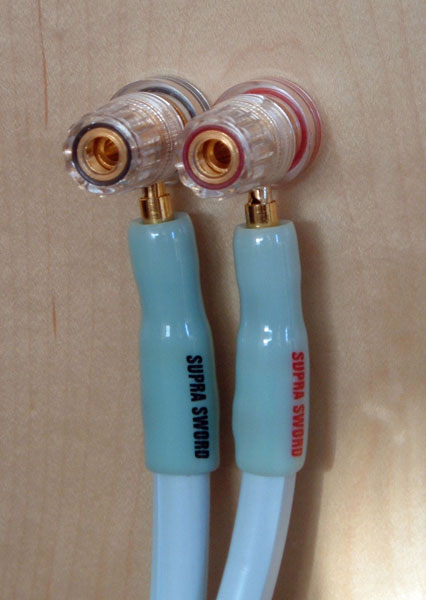
Jacro skrev:Objektivisten skrev:Hell James
Objektivisten,
Curious... I'm not sure of what the significance of this statement is.
All the best,
- James
petersteindl skrev:Jacro skrev:Objektivisten skrev:Hell James
Objektivisten,
Curious... I'm not sure of what the significance of this statement is.
All the best,
- James
There is an o missing.
It should have been Hello JamesQuite a big difference
![]()
Best Regards
Peter
paa skrev:Jacro skrev:Objektivisten skrev:Hell James
Objektivisten,
Curious... I'm not sure of what the significance of this statement is.
All the best,
- James
If we assume it's correctly spelled, the swedish expression "hell" means "hail", although that word is not yet included in google translations.
Thanks for your answers again, by the way.
Jacro skrev:petersteindl skrev:Jacro skrev:Objektivisten skrev:Hell James
Objektivisten,
Curious... I'm not sure of what the significance of this statement is.
All the best,
- James
There is an o missing.
It should have been Hello JamesQuite a big difference
![]()
Best Regards
Peter
Thank you, Peter.
I feel better now.
- James
Stereotypen skrev:Jacro:
It would be very interesting for me to hear what you think about the Audio Artistry Beethoven system. This is the speaker that I use myself. Here in Sweden there is a very limited amount of people that own this speaker but I guess that in the US they are more common. Have you heard them? What is your impression/oppinion of them? What is your oppinion of dipole bass in general?
The speakers are not manufactured any more so I guess it would be ok for you to comment on them.
Jacro skrev:...
OR,
2) Arrange for the first four boundary distances to be cross-relational such that they are distributed and/or cross-cancelling. In the second case, the system would ideally, have a smooth, but complex transitional power response that is calibrated to match the predetermined boundary interaction.
Both are rather complex to develop, and the second approach is the basis for the operation of The Clue.
...
- James
Jacro skrev:(By the way, the post of Naqref’s stopped after only 2 pages… Was there further work and measurements reported on the experimental devices?)
paa skrev:I found the Bremen egg spekers to present a somewhat larger soundstage depthwise than sidewise when they were displayed at the Stockholm High End Show a couple of weeks ago. (With front speaker and proprietary matrix center decoding.)
Perhaps that was because they were placed on the sidewalls, positioned a bit back from the front wall, and the room was longer than wide, could that have been mainly a visible illusion too?
Objektivisten skrev:Hi James, welcome to the forum, what do You think is the secret about tubes and that they almost always sounding more pleasant and true to the ears? And do we really need all that watts, low powered amps seems to gain in transparent sound, may be construction simplicity or cost effectiveness?
Objektivisten skrev:8O Holy macaroni, the significance of my 'statement' is zero (maybe below) James. Can we please go back to the real substance in this thread, your eminent inputs and answers.Regards
sportbilsentusiasten skrev:Thanks for the list Jacro!
I'm also a fan of QUAD, lovely speakers![]()
Can you please elaborate on pi60's "promising characteristics"?Jacro skrev: Here are a few currently available loudspeakers that, in my opinion, have promising characteristics.
AudioKinesis Dream Maker
Emerald Physics CS2.3
Ino Audio pi60
Vinylcalle skrev:I have been reading this thread from the begining and want to say thanks to James for all the time he puts into giving us some great information. Especially the last answer about damping factor and amplifier research was great.
Well since I have got the opportunity I might as well ask you a question James.
Whats your view on vintage-hifi? I often get the feeling that there haven´t been much significant development since the golden days in the late 70s early 80s. If their is one thing that has changed its perhaps that there is more badly constructed equipment on the market today.
Some of my audiophile friends doesn´t agree, they´re basicly the ones who don´t believe in blind tests either.![]()
Have you ever come across some of the old Denon totl equipment like poa3000,poa1500 and pma790? I think their great and some of the best amps I ever heard.
Best Regards Carl
Naqref skrev:Jacro skrev:(By the way, the post of Naqref’s stopped after only 2 pages… Was there further work and measurements reported on the experimental devices?)
Hello James,
Finally I had som time (and focus) to read the whole thread and I'm very impressed as many others.
Regarding My little sweetheart it's scrapped but I'll think I have some measurement of it somewhere in one of my computers. Perhaps I'll find it and then I'll post some information here (and in the original thread).
The first ambience-module with the principle was made around 1995. A couple of years later I built the one on the pictures. I was still a poor student at the time so there was actually no money to develop the principle then. And then I found other things more promising.
I found your patent:
http://www.freepatentsonline.com/7551062.pdf
Impressive. I'll think the right way to go ist to use multiple active units just as you say. Passive damping of the sound from the back of the unit is to test intensive to get right.
I am like you intrested in what I call wall integrated speakers. It should perhaps be altered to external wall integrated speakers (EWI) or something like that to avoid beeing misstaken for in-wall-speakers. But anyhow. I'm the designer of Larsen speakers (it's a follow up of Carlsson). Two major problems with ewi-speakers is the perception of depth and excitment of roomresonances I'll think. The problem with depth is that the mind has problems to project auditory sources beyond the visual boundaries. The eye's override of other senses is making it harder to imagine a sound stage beyond the front wall. Do you think this is a big problem and if so what else is there to do about it other than removal of visual clues or to give additional visual clues to aid the sound stage?
The second problem (actually it's really a problem with almost every type of speaker), what is your preffered method of dealing with that? Acoustical lf-absorbers, parametrical eq or perhaps using multiple sound sources to counter act the resonanses?
Send my regards to Lars Erickson.
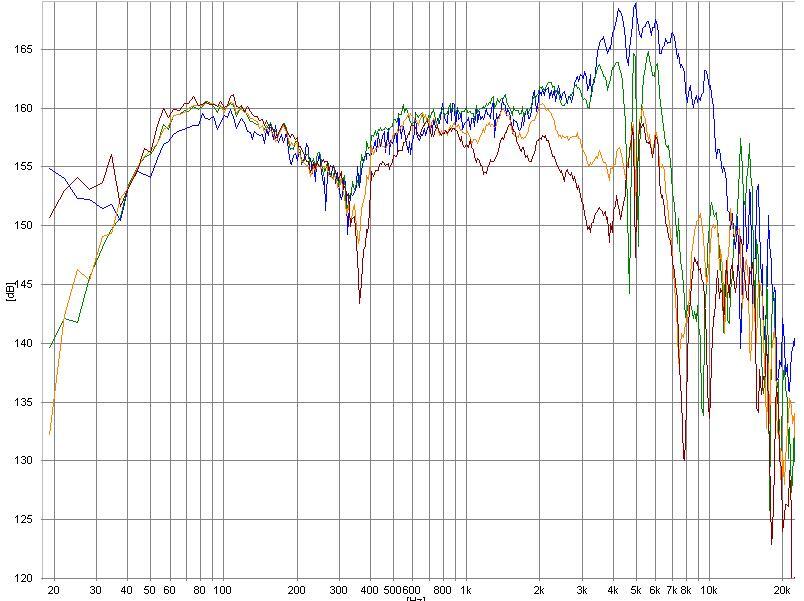
paa skrev:Hello James,
Earl Geddes seems to say this is as good sound distribution as you need;
Could those curves be close to any goal you would want to reach?
Is it ok to have that much wider dispersion below 1 kHz than above?
Maybe the bass couples to the boundries and thus tends to narrow its dispersion a bit more than higher frequencies does?
JanBanan skrev:Jacro skrev:I am currently working on a new type of low frequency system.
Hell James,
This sounds exciting! Is this something you can elaborate on?
Jacro skrev:I hope that the Google translator doesn't provide too many embarrassing mistakes. I often translate from English to Swedish, and then translate the Swedish back to English again, to see what it says, and the errors can be quite entertaining.
Jacro skrev:Naqref skrev:Jacro skrev:(By the way, the post of Naqref’s stopped after only 2 pages… Was there further work and measurements reported on the experimental devices?)
Hello James,
Finally I had som time (and focus) to read the whole thread and I'm very impressed as many others.
Regarding My little sweetheart it's scrapped but I'll think I have some measurement of it somewhere in one of my computers. Perhaps I'll find it and then I'll post some information here (and in the original thread).
The first ambience-module with the principle was made around 1995. A couple of years later I built the one on the pictures. I was still a poor student at the time so there was actually no money to develop the principle then. And then I found other things more promising.
I found your patent:
http://www.freepatentsonline.com/7551062.pdf
Impressive. I'll think the right way to go ist to use multiple active units just as you say. Passive damping of the sound from the back of the unit is to test intensive to get right.
I am like you intrested in what I call wall integrated speakers. It should perhaps be altered to external wall integrated speakers (EWI) or something like that to avoid beeing misstaken for in-wall-speakers. But anyhow. I'm the designer of Larsen speakers (it's a follow up of Carlsson). Two major problems with ewi-speakers is the perception of depth and excitment of roomresonances I'll think. The problem with depth is that the mind has problems to project auditory sources beyond the visual boundaries. The eye's override of other senses is making it harder to imagine a sound stage beyond the front wall. Do you think this is a big problem and if so what else is there to do about it other than removal of visual clues or to give additional visual clues to aid the sound stage?
The second problem (actually it's really a problem with almost every type of speaker), what is your preffered method of dealing with that? Acoustical lf-absorbers, parametrical eq or perhaps using multiple sound sources to counter act the resonanses?
Send my regards to Lars Erickson.
Hi Naqref,
Good to hear from you.
You mention two issues related to “EWI” loudspeakers:
(Over here we differentiate from "In-Wall" by calling them either; "On-Wall" or "Boundary Coupled"):
1) Perception of depth
2) Excitement of Room Resonances
I'm not clear on what you are referring to with #2. I think you are referring to reflections off the near boundary, but that is not actually a "resonance" per say. So, to discuss number 2, it would be good if you can clarify for me.
So, in terms of depth perception, in one way it is a problem (difficulty in imagining depth through a wall) and in another way, it is an improvement, in that it doesn't create "false depth" due to reflections off of the wall, spaced some distance behind the loudspeaker.
Loudspeakers spaced away from the front wall tend to create some degree of a false sense of depth depending on the ratio of the direct energy vs. the intensity of the energy reflected back to the listener.
So, in this regard, the boundary coupled systems are more faithful to reproducing the actual depth captured on the recording. (This is an over simplification, due to there being many additional variables determining perceived depth).
Your other observation, of the visual wall blocking our ability to imagine depth behind the wall, can be a significant limitation with some listeners. It is not a universal problem, but certainly a problem for many. Initially, I found it to be problematic for myself.
Sometimes I listen with my eyes closed, when listening to reproduced sound through loudspeakers, and also when I am at a live concert. In both cases, I find that the visual aspects alter my perception of the aural event, so closing my eyes creates a more equivalent situation for comparing live vs. reproduced sound.
If I have my eyes open at a live concert, I perceive the individual instruments as being more focused in a specific location in space than if my eyes are closed. Also, with eyes open, I "visualize" more depth of field, commensurate with the actual stage depth. If I close my eyes at a live concert, then the location of instruments is more vague, less focused, and the perception of depth of field is less.
So, if we are attempting to transport the actual focus, and scale of the sound sources to our listening room, without the actual musicians being visually present, the boundary coupled system is actually a more “accurate” facsimile of the spatial dimension of the original event.
(In a smaller second venue, boundary coupled loudspeakers and loudspeakers out in the room both distort the image compared to the original, but the loudspeakers that are out in the room (unless highly directional) will add more artificiality to the reproduced sound.
To minimize the visual barrier (for some customers that find it bothersome), but still have a boundary-coupled relationship for the loudspeakers, I have developed an alternative use-model.
Let’s see if I can explain it without a drawing.
Instead of facing the front wall of the room, the listener faces into a corner of the room. As an example, the listener might sit 3-meter’s straight out from the corner, and the left loudspeaker is coupled to the wall that extends to the left of the corner, and the other loudspeaker is coupled to the wall that extends to the right of the corner. The distance between the two loudspeakers and the distance from the loudspeakers to the listener are the same as they normally would be, and the loudspeakers are angled, or aimed, in relation to the listener, as they normally would be.
Visually, the corner extends back behind the loudspeakers, but the loudspeakers are effectively boundary coupled to each wall as they normally would be on the front wall.
I usually put extra absorption/diffusion in the corner, such as a quarter round of a half-meter radius, covered with 100 mm of foam, and I use a larger piece of absorption on the wall where the loudspeaker is coupled.
With an angled configuration, such as the Larsen 4, 6, or 8, the right loudspeaker may work better on the left side, and visa versa.
Make sense?
If properly set up, this has a few advantages, two of which are; it provides a visual expansion of depth, and it can leverage a more effective boundary coupling (less than a half-space) which allows a small loudspeaker to better power a larger room.
I use this approach for listeners that find the wall boundary mounting to be problematic for imagining depth, and/or for listeners who have rooms that are larger than what the loudspeaker is normally capable of filling.
This is a rather unorganized, non-technical discussion of the issue that you raised, but hopefully it is still somewhat useful.
I’ll address the rest later.
Best regards,
- James
PS – I’ll be sure to say hello to Lars for you.
paa skrev:Thanks James for your answer about directivety below 1kHz.
Now imagine that I manage to make loudspeakers that maintain directivety down to say 80Hz, and want to add some subwoofers to them:
If I place two subs in the front corners, they will be boundry coupled in their frequency range and have 90+90 degrees of dispersion which should be fine. But probably we play the subs in mono so now we have 180 degrees bass dispersion which is quite a bit more more than the theoretically perfect main speakers, how do we sort this out? And if we want one or two more subs to improve on room modes, how would all that effect frequency response vs power response in such a system?
Naqref skrev:Jacro skrev:Naqref skrev:Jacro skrev:(By the way, the post of Naqref’s stopped after only 2 pages… Was there further work and measurements reported on the experimental devices?)
Hello James,
Finally I had som time (and focus) to read the whole thread and I'm very impressed as many others.
Regarding My little sweetheart it's scrapped but I'll think I have some measurement of it somewhere in one of my computers. Perhaps I'll find it and then I'll post some information here (and in the original thread).
The first ambience-module with the principle was made around 1995. A couple of years later I built the one on the pictures. I was still a poor student at the time so there was actually no money to develop the principle then. And then I found other things more promising.
I found your patent:
http://www.freepatentsonline.com/7551062.pdf
Impressive. I'll think the right way to go ist to use multiple active units just as you say. Passive damping of the sound from the back of the unit is to test intensive to get right.
I am like you intrested in what I call wall integrated speakers. It should perhaps be altered to external wall integrated speakers (EWI) or something like that to avoid beeing misstaken for in-wall-speakers. But anyhow. I'm the designer of Larsen speakers (it's a follow up of Carlsson). Two major problems with ewi-speakers is the perception of depth and excitment of roomresonances I'll think. The problem with depth is that the mind has problems to project auditory sources beyond the visual boundaries. The eye's override of other senses is making it harder to imagine a sound stage beyond the front wall. Do you think this is a big problem and if so what else is there to do about it other than removal of visual clues or to give additional visual clues to aid the sound stage?
The second problem (actually it's really a problem with almost every type of speaker), what is your preffered method of dealing with that? Acoustical lf-absorbers, parametrical eq or perhaps using multiple sound sources to counter act the resonanses?
Send my regards to Lars Erickson.
Hi Naqref,
Good to hear from you.
You mention two issues related to “EWI” loudspeakers:
(Over here we differentiate from "In-Wall" by calling them either; "On-Wall" or "Boundary Coupled"):
1) Perception of depth
2) Excitement of Room Resonances
I'm not clear on what you are referring to with #2. I think you are referring to reflections off the near boundary, but that is not actually a "resonance" per say. So, to discuss number 2, it would be good if you can clarify for me.
So, in terms of depth perception, in one way it is a problem (difficulty in imagining depth through a wall) and in another way, it is an improvement, in that it doesn't create "false depth" due to reflections off of the wall, spaced some distance behind the loudspeaker.
Loudspeakers spaced away from the front wall tend to create some degree of a false sense of depth depending on the ratio of the direct energy vs. the intensity of the energy reflected back to the listener.
So, in this regard, the boundary coupled systems are more faithful to reproducing the actual depth captured on the recording. (This is an over simplification, due to there being many additional variables determining perceived depth).
Your other observation, of the visual wall blocking our ability to imagine depth behind the wall, can be a significant limitation with some listeners. It is not a universal problem, but certainly a problem for many. Initially, I found it to be problematic for myself.
Sometimes I listen with my eyes closed, when listening to reproduced sound through loudspeakers, and also when I am at a live concert. In both cases, I find that the visual aspects alter my perception of the aural event, so closing my eyes creates a more equivalent situation for comparing live vs. reproduced sound.
If I have my eyes open at a live concert, I perceive the individual instruments as being more focused in a specific location in space than if my eyes are closed. Also, with eyes open, I "visualize" more depth of field, commensurate with the actual stage depth. If I close my eyes at a live concert, then the location of instruments is more vague, less focused, and the perception of depth of field is less.
So, if we are attempting to transport the actual focus, and scale of the sound sources to our listening room, without the actual musicians being visually present, the boundary coupled system is actually a more “accurate” facsimile of the spatial dimension of the original event.
(In a smaller second venue, boundary coupled loudspeakers and loudspeakers out in the room both distort the image compared to the original, but the loudspeakers that are out in the room (unless highly directional) will add more artificiality to the reproduced sound.
To minimize the visual barrier (for some customers that find it bothersome), but still have a boundary-coupled relationship for the loudspeakers, I have developed an alternative use-model.
Let’s see if I can explain it without a drawing.
Instead of facing the front wall of the room, the listener faces into a corner of the room. As an example, the listener might sit 3-meter’s straight out from the corner, and the left loudspeaker is coupled to the wall that extends to the left of the corner, and the other loudspeaker is coupled to the wall that extends to the right of the corner. The distance between the two loudspeakers and the distance from the loudspeakers to the listener are the same as they normally would be, and the loudspeakers are angled, or aimed, in relation to the listener, as they normally would be.
Visually, the corner extends back behind the loudspeakers, but the loudspeakers are effectively boundary coupled to each wall as they normally would be on the front wall.
I usually put extra absorption/diffusion in the corner, such as a quarter round of a half-meter radius, covered with 100 mm of foam, and I use a larger piece of absorption on the wall where the loudspeaker is coupled.
With an angled configuration, such as the Larsen 4, 6, or 8, the right loudspeaker may work better on the left side, and visa versa.
Make sense?
If properly set up, this has a few advantages, two of which are; it provides a visual expansion of depth, and it can leverage a more effective boundary coupling (less than a half-space) which allows a small loudspeaker to better power a larger room.
I use this approach for listeners that find the wall boundary mounting to be problematic for imagining depth, and/or for listeners who have rooms that are larger than what the loudspeaker is normally capable of filling.
This is a rather unorganized, non-technical discussion of the issue that you raised, but hopefully it is still somewhat useful.
I’ll address the rest later.
Best regards,
- James
PS – I’ll be sure to say hello to Lars for you.
What you say makes a lot of sense. I hade tried to convince people of using the adjacent walls in a corner and shift right and left speaker in some cases but the look at me like they think; "Are you crazy or something"Perhaps I should work on my way of convincing people more to adress this problem.
Anyhow I think the problem is non existing when you have a picture of some sort between the boundary coupled (better word than mine at least in English) speakers. Like a TV or a projector screen.
Perhaps using mirrors (with some parts of the surface that are opaque) could do the trick?
My second question was about the normal resonances you have in a rectangular room (where you always have pressure nodes and velocity antinodes in the corners). A boundary coupled (just because it's places close to the walls) excite or trigger thes resonances more than free-standing speakers. At higher frequencys as you know the resonances have a modal density that is so high that single resonanses can't be heard. But at low frequencys (below 100 Hz or so) they can be quite problematic. As I see it there are (at least) three methods that can be used against these resonanses;
1. Using absorbtion (helmholtz, mass surface absorbers or large normal sound absorbers).
2. Using multiple or distributed sound sources. If you place a single sound source at in a place in the room where there is a pressure node for a certain frequency then it will trigger that corresponding resonance. But if you place a second correlated sound source at another pressure node for that frequency then that resonance can't be triggered. One way to use this technique is to use several subwoofers for the range of 0-100Hz and place them in a pattern that supresses these resonances.
3. Using a parametric eq.
Does my explanation makes my question more clear?
Reagards
Anders Eriksson
sportbilsentusiasten skrev:
What is according to you the best length to width ratio?
Is that ratio different depending of speakers used?
Jacro skrev:I have lost track of which issues remain unanswered. If there are any questions that someone has submitted for me to answer that I have not responded to, or if there any that I have not answered completely of which there is still interest in further discussion, please let me know.?
paa skrev:Jacro skrev:...
OR,
2) Arrange for the first four boundary distances to be cross-relational such that they are distributed and/or cross-cancelling. In the second case, the system would ideally, have a smooth, but complex transitional power response that is calibrated to match the predetermined boundary interaction.
Both are rather complex to develop, and the second approach is the basis for the operation of The Clue.
...
- James
How can this be made to work for different room sizes, and different listening distances, things that also would demand different distances between the speakers?
Could this cross-relational and cross-cancelling function be simulated in some known software?
Jacro skrev:
To make a couple statements until I can get back with complete answers, I would say that I am generally an advocate of "Global", preemptive, solutions (such as modifying the room, loudspeaker configuration and location, and using multiple woofer systems), as opposed to "local", post-corrective solutions (such as digital room correction).
There are a number of ways to implement multiple woofers. I have a new couple of new ways that I have found that exhibit interesting results when compared to some of the current conventional approaches of Welti and Geddes. I'll speak more about them when I get back to complete my answers.
More later...
Best regards,
- James
avr7000 skrev:Hello Jacro
Is there a possibly somewhere for me to listen to, and maybe buy, the clue speakers in either:
New York
Grand Rapids
Richmond
-and maybe Chicago.
Regards
Stefan
paa skrev:Jacro skrev:I have lost track of which issues remain unanswered. If there are any questions that someone has submitted for me to answer that I have not responded to, or if there any that I have not answered completely of which there is still interest in further discussion, please let me know.?
I believe this is long lost:paa skrev:Jacro skrev:...
OR,
2) Arrange for the first four boundary distances to be cross-relational such that they are distributed and/or cross-cancelling. In the second case, the system would ideally, have a smooth, but complex transitional power response that is calibrated to match the predetermined boundary interaction.
Both are rather complex to develop, and the second approach is the basis for the operation of The Clue.
...
- James
How can this be made to work for different room sizes, and different listening distances, things that also would demand different distances between the speakers?
Could this cross-relational and cross-cancelling function be simulated in some known software?
Then there was the discussion about power response with multiple subwoofers, where you said you had something more coming.
Jacro skrev:...
It is based on the use of a subwoofer on each of the four walls, with the relationship of each woofer being that of an increasing 1.618 relationship of each woofer to a corner. The first woofer is placed at a distance from a first corner that is based on a specific value relating to a constant relative to room dimensions. The second woofer is placed 1.618 times that distance from the second corner. Third woofer placed, relative to the third corner, 1.618 times the distance of the second woofer, and the fourth, 1.618 of the third. The phase of woofers 2, 3, and 4 are tested individually with reversed phase (usually woofer 2 or 3 work best with phase reversed)
This simple approach produces surprisingly consistent results.
...
Cheers,
- James
Kraniet skrev:Toole also argues against* placing bass around the room. One in every corner och one in the middle of every wall are some of the tips. Arguing that more bass speaker are better but above four is hitting diminish return.
Ingvar Öhman argues that the bass should preferably come from the front. That this would bring whats a more "pshycoacoustical correct wavefront".
Any comment in regard to this?
edit: sorry meant to say against not "for"
Jacro skrev:paa skrev:Thanks James for your answer about directivety below 1kHz.
Now imagine that I manage to make loudspeakers that maintain directivety down to say 80Hz, and want to add some subwoofers to them:
If I place two subs in the front corners, they will be boundry coupled in their frequency range and have 90+90 degrees of dispersion which should be fine. But probably we play the subs in mono so now we have 180 degrees bass dispersion which is quite a bit more more than the theoretically perfect main speakers, how do we sort this out? And if we want one or two more subs to improve on room modes, how would all that effect frequency response vs power response in such a system?
paa,
My computer is in for repair for a few days, so I will have to wait to address this question more completely as soon as my computer is returned to me.
You ask a good question. Part of the answer is that it is most important to maintain the directivity down to the Schroeder frequency. Below the Schroeder frequency things change and to some degree, the sound source becomes the room modes themselves, as opposed to the loudspeaker, but that is a concept that needs some further explanation.
I hope to get back to you with more on this topic in a few days.
All the best,
- James
paa skrev:Hi James,
Once again, thanks for your patience with all our questions.
However much I await more about these things I have a follow up question here.
Are there no problems when every subwoofer stand at different distances from the listener? How much difference can be tolerated?
paa skrev:Hello James,
Do you have any more information about the Schroeder frequency, and its importance in small rooms?
Jacro skrev:My goal with the front hemisphere woofer arrangement, is to still address the most significant modal characteristics of the room, and this can be accomplished in the frontal portion of the room, but one must think three dimensionally.
This requires placing woofers in an arrangement that is not only horizontal, x-axis, but also to diversify in the y and z-axis, with at least one woofer above the half-height point of the room. With this approach, one can substantially accomplish the modal control of woofers placed on each of the four walls, while still maintaining 100% frontal wavelaunch.
Nattlorden skrev:Jacro skrev:My goal with the front hemisphere woofer arrangement, is to still address the most significant modal characteristics of the room, and this can be accomplished in the frontal portion of the room, but one must think three dimensionally.
This requires placing woofers in an arrangement that is not only horizontal, x-axis, but also to diversify in the y and z-axis, with at least one woofer above the half-height point of the room. With this approach, one can substantially accomplish the modal control of woofers placed on each of the four walls, while still maintaining 100% frontal wavelaunch.
I'm stacking my woofers in the front coners - floor to ceiling. Does this conform, or would you also say I'd need some inbetween?
And what's your view about stereo vs. mono for (sub)woofers, say crossed at 80Hz?
And also something completely different - as I take it you've been around a lot over the years - have you crossed paths with Albert Von Schweikert and if so, have you any stories or such to tell about it?
paa skrev:James, how do you manage to have all these different crossover frequencies and shared frequency ranges to sum at something close to phase coherence?
MagnusÖstberg skrev:Hi James!
Such low crossover frequency as 40-50hz puts large demands on the main to be able to move substantial amount of air.
Don´t you see the advantage of having the larger woofers operate up to 80-100hz as that definetly makes things easier for the mains who can concentrate on upper bass and above? Why put that extra stress on them?
Not exactly as "Basstöd" is limmited to one woofer per channel, passively connected to the mains.paa skrev:I womder if this concept is similar to the products called "basstöd" by ino?
paa skrev:I wonder if this concept is similar to the products called "basstöd" by ino?
Hi!Jacro skrev:MagnusÖstberg skrev:Hi James!
Such low crossover frequency as 40-50hz puts large demands on the main to be able to move substantial amount of air.
Don´t you see the advantage of having the larger woofers operate up to 80-100hz as that definetly makes things easier for the mains who can concentrate on upper bass and above? Why put that extra stress on them?
Hi MagnusÖstberg,
I agree with you.
What I had stated it previously, but I forgot to mention again in the last post, is that I always "shelf down" my mains by approximately 6 to 12 dB to reduce the load on the main loudspeakers, but keep them active at that reduced level from 80 or 100 Hz down to their lower limit, to provide a more effective integration with the subwoofers and to create a greater number of diverse sources of bass in the room for further improvements in smoothness.
The greater the number of subwoofers that are added, the greater the amount of LF amplitude reduction can be applied to the mains, reducing their output requirements.
Make sense?
- James
jacro skrev:2) using a near field woofer close to the listening seat, such that the dominant arrival is the direct arrival from the woofer itself (this is a superior technique not commonly used in the industry as of yet. I believe this approach is ahead of its time and will become a standard in another 5 to 10 years. We have developed systems using this approach that consistently outperform all other approaches)
Jacro skrev:paa skrev:I wonder if this concept is similar to the products called "basstöd" by ino?
paa,
I am not familiar with "basstöd".
Can you explain the concept?
Thank you,
- James
celef skrev:jacro skrev:2) using a near field woofer close to the listening seat, such that the dominant arrival is the direct arrival from the woofer itself (this is a superior technique not commonly used in the industry as of yet. I believe this approach is ahead of its time and will become a standard in another 5 to 10 years. We have developed systems using this approach that consistently outperform all other approaches)
i'm surprised none haven't commented the above, i'm not sure i understand the meaning of it but it sounds to me like the subwoofer placement in early home cinema setups, like coffee table subwoofers, i'm sure this is not what you're saying?
paa skrev:celef skrev:jacro skrev:2) using a near field woofer close to the listening seat, such that the dominant arrival is the direct arrival from the woofer itself (this is a superior technique not commonly used in the industry as of yet. I believe this approach is ahead of its time and will become a standard in another 5 to 10 years. We have developed systems using this approach that consistently outperform all other approaches)
i'm surprised none haven't commented the above, i'm not sure i understand the meaning of it but it sounds to me like the subwoofer placement in early home cinema setups, like coffee table subwoofers, i'm sure this is not what you're saying?
I'm wondering if a listener moving relative to the closely placed subwoofer would upset the balance of the percieved frequency response.
MagnusÖstberg skrev:Hi!Jacro skrev:MagnusÖstberg skrev:Hi James!
Such low crossover frequency as 40-50hz puts large demands on the main to be able to move substantial amount of air.
Don´t you see the advantage of having the larger woofers operate up to 80-100hz as that definetly makes things easier for the mains who can concentrate on upper bass and above? Why put that extra stress on them?
Hi MagnusÖstberg,
I agree with you.
What I had stated it previously, but I forgot to mention again in the last post, is that I always "shelf down" my mains by approximately 6 to 12 dB to reduce the load on the main loudspeakers, but keep them active at that reduced level from 80 or 100 Hz down to their lower limit, to provide a more effective integration with the subwoofers and to create a greater number of diverse sources of bass in the room for further improvements in smoothness.
The greater the number of subwoofers that are added, the greater the amount of LF amplitude reduction can be applied to the mains, reducing their output requirements.
Make sense?
- James
I must admit I don´t fully understand the meaning of extending the mains further down than 70-100hz, as they still will give some output down to around 50-70hz, even using a 5th order acoustic roll-off. This still means that the bassmodules can be placed fairly free from the mains because of the long wavelenght without compromissing.
I would say that the greater numbers of subwoofers used we will get greater LF amplitude reduction in the subwoofer range, thus increased headroom in the bass range. And ofcourse the acoustic advantage one can achive using multiple woofers spread out. But there will be no reduction in stress for the mains using my way, that is true.
However, I like the idea of letting more stress off the mains. This will however, as I see it, result in special demands om both filter and woofers. Let us play with the thought of gradually reduce the main output under 300hz with 6db/octav down to 75hz where they start rolling-off with 30dB/octav. This would mean that the woofers would have to be able to play up to +600hz - and placement would be more critical.
All in all, I think this route is too complex and will not give bennefit in comparison with the eefort put in. Better to make sure the main can handle all the output you need as long as they are cut crossed over acustically with 5th order around 70-90hz.
What is your thoughts around this?
Best regads
Magnus
Jacro skrev:paa skrev:James, would you think the HOM reduction foam also works as an acoustic lens that further smothes the dispersion whithin the desired coverage angle?
Interesting idea.
The current goal of applying foam to a waveguide to reduce HOMs is to be able to maintain consistent absorption such that directivity is not changed from the ideal directivity of the waveguide. Correctly applied, directivity does not change when the foam is applied.
Attempting to use the foam to change directivity does add a degree of complexity that may be difficult to fully characterize. As one changes absorption rates, it must be achieved in a manner that the absorption discontinuities don't increase HOMs, simulating diffractive effects.
That said, the concept of using the foam to alter directivity while reducing HOMs may be a very good idea. The ability to provide an addition variable to control directivity in waveguides may allow one to relax the directivity capability of a waveguide in order to achieve an improvement of some other parameter (such as efficiency, or bandwidth, etc.), and then re-optimize the directivity with a variable density foam insert.
Definitely worth exploring.
- James
jeppe skrev:hmm, ja olika forum och recensioner stärkte köpbeslutet sen var det mycket hur konstruktören kan förklara varje aspekt av konstruktionen och tänket bakom lösningarna.

jeppe skrev:Hello James, I hope you still visit faktiskt every now and then.
I´ve been living with (the clue) now for about a month and I just want to say a few words about them. They are not good or very good but utterly brilliant!![]()
I bought them unheard and now I can´t stop listening to them.
thanks!!
Jacro skrev:(the clue) has been a rewarding project. It is one of the lowest priced loudspeakers I have ever designed, but by incorporating the novel sound field construct, it provides advantages over more expensive approaches.
Most of all, we wanted (the clue) owners to have more fun with music, so I'm very happy to hear that you are enjoying your new loudspeakers.
Cheers,
- James
Fy fan va fett, grattis. Nej jag har inte beställt, jag har väntat på att du ska göra det först.jeppe skrev:hmm, ja olika forum och recensioner stärkte köpbeslutet sen var det mycket hur konstruktören kan förklara varje aspekt av konstruktionen och tänket bakom lösningarna.
metheny skrev:Jacro skrev:(the clue) has been a rewarding project. It is one of the lowest priced loudspeakers I have ever designed, but by incorporating the novel sound field construct, it provides advantages over more expensive approaches.
Most of all, we wanted (the clue) owners to have more fun with music, so I'm very happy to hear that you are enjoying your new loudspeakers.
Cheers,
- James
Hi, sorry for not having read the whole thread, the answer might already have been given. But I'm wondering if the elements are of custom design or "off-the-shelf"? Will it be possible to buy the speaker as a kit, i.e just the filter components and the elements together with instructions on how to build the boxes?
_Fredrik_ skrev:Fy fan va fett, grattis. Nej jag har inte beställt, jag har väntat på att du ska göra det först.jeppe skrev:hmm, ja olika forum och recensioner stärkte köpbeslutet sen var det mycket hur konstruktören kan förklara varje aspekt av konstruktionen och tänket bakom lösningarna.![]()
Va roligt att du är nöjd!
Ragnwald skrev:jeppe, vad fick du betala allt som allt, för ett par?
jeppe skrev:mailade Sjöfn och fick det glädjande beskedet att dom har sänkts till 999 dollars och exporteras direkt från Sjöfn hifi, alltså inga omvägar via butik.
Tog väl en vecka tills jag hade dom. Kostade allt som allt (ink moms) 7700 sek.
jeppe skrev:mailade Sjöfn och fick det glädjande beskedet att dom har sänkts till 999 dollars och exporteras direkt från Sjöfn hifi, alltså inga omvägar via butik [..] Kostade allt som allt (ink moms) 7700 sek.
luminous skrev:Hi Jacro,
I have been reading your posts in this thread with great interest. I was wondering if you would like to share your view on this topic:
How can you tell, by taking measurements, that you have achieved a neutral perceived timbre (flat perceived frequency response) in a room?
Most people seems to agree that the goal isn't just a flat in-room frequency response, but there doesn't seem to be a generally accepted answer to this question either.
Regards, Viktor

Ultimately, one must arrive at a power response emitted from the loudspeaker system (the amplitude/response curve “emitted IN each direction”) that creates the “head related power response” (amplitude at each frequency “received FROM” each direction) that is appropriate to create timbral and spatial neutrality.
There are well-defined vector/amplitude sets that provide the most neutral timbre, but they are inextricably related to the use configuration model of the loudspeaker device.
This includes the boundary relationship of the transducer, including 'global' listening environment boundaries and 'local' enclosure boundaries.
If the device is boundary coupled to the front wall, floor, sidewall, or free standing, requires a very different radiation pattern. And each of these placement models has a range of parameters to be defined, again related to the environment and enclosure relationships (front of enclosure to boundary, vs. back and sides of enclosure to boundaries).
The use model also includes the relationship of the listener’s upper body to the transducer/enclosure, such as angle (vertical and horizontal), distance, etc.
Example: Depending on wave launch source position relationship to listener, the optimal power response will differ.
This is just a small subset of the variations that must be taken in to consideration.
Unfortunately, most loudspeaker manufacturers still don’t define a specific use model (because they want to let people use the speakers where ever it is convenient) so for most loudspeakers, it is not possible to accurately define an effective power response.
Each use model, once clearly defined, has a unique optimal radiation pattern/power response.
Once the use model and boundary relationship and listener relationship is defined then a specialized set of measurements must be taken to calibrate the power response.
To be truly effective, this is not defined by just measuring the radiation pattern outward from the loudspeaker.
One approach is to measure the polar response outward from the device under test, with a more precision angle weighting function depending on angle, with certain angles tangent to the listening position differentiated from all other angles with a specific non-linear priority.
Then, with a varying boundary set (multiple room sizes and forms) one measures a “reception” power response at the listener’s torso (upper body).
Ultimately, while measuring the power response “IN all directions” from the loudspeaker, one is really only providing a beginning step in defining what is more important, which is what is the amplitude response of arrivals at the listener “FROM all directions”.
By having a defined set of amplitude vs. frequency arrivals “from each direction” one can work back to the loudspeaker device being calibrated for a power response of how it should radiate “in all directions”.
This is combined with a few other adjustments and design processes that impact the sound field around the listener’s head.
To make the matter even more complex, the ideal power response is not a single channel, emission definition, but must be calibrated to the channel count employed to achieve an optimal spatial response while maintaining timbral neutrality. This requires the power response from each loudspeaker to be recalibrated differently for “stereo” if timbre is to be maintained and “multi-channel coloration” minimized.
Then, the next step, depending on the architecture of the loudspeaker, ideally, one optimizes the polar response(s) to maintain neutrality across a listening window wide enough for at least three listeners seated beside each other. Some loudspeaker system topologies allow for this adaptation more than others.
Again, depending on the type of emission architecture (dipole, monopole, free-standing, ½ space, ¼ space..., etc.) and use model (listener/loudspeaker/environment relationship) the above stated calibration technique will result in a unique amplitude/vector set for each system type.
Hopefully, what I have written so far is of interest, even though it does not provide a quick and simple answer to the very important question that was asked.
I’ll see if there is feedback on what I’ve written so far, and if there is interest, we can explore further towards a more complete answer.
celef skrev:i really like your posts jacro and i'm glad you still visiting us!
whats your opinion of all those loudspeaker measruements that stereophile and soundstage are providing, are they a helpful tool for sorting out poorly deisgned speakers or are they just confusing for most readers?
Ragnwald skrev:The thread has rendered to be very long, so i hope my question not have been up before.
As we see in this picture, there is an ideal angle against the wall, but i want to know ideal distance between speakers, and the ideal listening position? And have distance to sidewalls any influence?
luminous skrev:Hi James,
Since your answer is quite long I have made quite many quotes below:Ultimately, one must arrive at a power response emitted from the loudspeaker system (the amplitude/response curve “emitted IN each direction”) that creates the “head related power response” (amplitude at each frequency “received FROM” each direction) that is appropriate to create timbral and spatial neutrality.
How do you define spatial neutrality? The spatial aspects of reproduction (sensation of room, envelopement, liveliness etc) ought to be rather subject to individual taste, and most recordings are not meant for "sound field reproduction" but to create a pleasurable experience...There are well-defined vector/amplitude sets that provide the most neutral timbre, but they are inextricably related to the use configuration model of the loudspeaker device.
This includes the boundary relationship of the transducer, including 'global' listening environment boundaries and 'local' enclosure boundaries.
If the device is boundary coupled to the front wall, floor, sidewall, or free standing, requires a very different radiation pattern. And each of these placement models has a range of parameters to be defined, again related to the environment and enclosure relationships (front of enclosure to boundary, vs. back and sides of enclosure to boundaries).
Do you mean that the "reference sound field" at the listening position differs with the use model?
Of course, the loudspeaker design would differ according to the loudspeaker use model if the same reference sound field at the listening position is the goal.
And by "There are well-defined vector/amplitude sets that provide the most neutral timbre", I don't know if I interpret vector/amplitude sets correctly but to define a sound field at the listener that provides the most neutral timbre, I guess one would need to have knowledge of how to go from "sound amplitude versus frequency versus angle of incidence versus time of incidence at the head" to perceived timbre, sounds like a very difficult problem to me.The use model also includes the relationship of the listener’s upper body to the transducer/enclosure, such as angle (vertical and horizontal), distance, etc.
Example: Depending on wave launch source position relationship to listener, the optimal power response will differ.
I guess it depends on what the goal of the source is, but if it is to generate the same perceived timbre regardless of source angle to the listener, then why should the design goal be different for different source angles? After all our brain should be expecting all modifications on the sound field that our body gives for different sound angles.This is just a small subset of the variations that must be taken in to consideration.
Unfortunately, most loudspeaker manufacturers still don’t define a specific use model (because they want to let people use the speakers where ever it is convenient) so for most loudspeakers, it is not possible to accurately define an effective power response.
I agree that it is a pity that not more manufacturers define a "use model" for their loudspeakers. They will never have full control over how the speakers will sound in peoples homes.Each use model, once clearly defined, has a unique optimal radiation pattern/power response.
Once the use model and boundary relationship and listener relationship is defined then a specialized set of measurements must be taken to calibrate the power response.
To be truly effective, this is not defined by just measuring the radiation pattern outward from the loudspeaker.
One approach is to measure the polar response outward from the device under test, with a more precision angle weighting function depending on angle, with certain angles tangent to the listening position differentiated from all other angles with a specific non-linear priority.
Then, with a varying boundary set (multiple room sizes and forms) one measures a “reception” power response at the listener’s torso (upper body).
Do you take actual measurements at a listening position with a listener present? How do you know what such measurements should look like?Ultimately, while measuring the power response “IN all directions” from the loudspeaker, one is really only providing a beginning step in defining what is more important, which is what is the amplitude response of arrivals at the listener “FROM all directions”.
By having a defined set of amplitude vs. frequency arrivals “from each direction” one can work back to the loudspeaker device being calibrated for a power response of how it should radiate “in all directions”.
This is combined with a few other adjustments and design processes that impact the sound field around the listener’s head.
I think the most interesting problem to discuss here is what kind of sound field you want to have at the listening location - if you know that, then it's a separate problem how you should design loudspeakers for a certain use model to achieve this.To make the matter even more complex, the ideal power response is not a single channel, emission definition, but must be calibrated to the channel count employed to achieve an optimal spatial response while maintaining timbral neutrality. This requires the power response from each loudspeaker to be recalibrated differently for “stereo” if timbre is to be maintained and “multi-channel coloration” minimized.
This is an interesting subject as well… Multiple loudspeakers will of course add in a complex manner. I imagine that they will add differently at a microphone than at a listener's head. And it should also depend on the music signal - if the sound is correlated or uncorrelated between the channels.Then, the next step, depending on the architecture of the loudspeaker, ideally, one optimizes the polar response(s) to maintain neutrality across a listening window wide enough for at least three listeners seated beside each other. Some loudspeaker system topologies allow for this adaptation more than others.
Again, depending on the type of emission architecture (dipole, monopole, free-standing, ½ space, ¼ space..., etc.) and use model (listener/loudspeaker/environment relationship) the above stated calibration technique will result in a unique amplitude/vector set for each system type.
Hopefully, what I have written so far is of interest, even though it does not provide a quick and simple answer to the very important question that was asked.
I’ll see if there is feedback on what I’ve written so far, and if there is interest, we can explore further towards a more complete answer.
For my part there is a large interest in these questions. Thanks for the meaty post!
/Viktor
Nattlorden skrev:
Clever. If I'd make speakers, and angling the front like NHT did isn't a good idea for some technical reasons, I'd consider making the box angled at the back... so placing them flat against the wall would put them at the correct angle.
Reading the placement instruction, I wonder if James and Ingvar shouldn't join forces, they seem to be on the (reasonably) same track.
Jacro skrev:1. Locate the loudspeakers on stands that are between approximately 19 and 22 inches in height.
2. Locate the loudspeakers within less than 2.5 inches of the wall behind them: the closer the better – but not actually touching the wall.
3. Position the loudspeakers so that the ratio of the distance between them (measured center-to-center) to the distance to your ears at the listening position is approximately 1 to 1.18.
(Example: 10.0 feet apart, center-to-center, AND 11.8 feet from a point halfway between the fronts of the two speakers, to your listening position.)
While the 1:1.18 ratio works well in most listening spaces, you might experiment with moving your listening spot a tad closer or further away; your room acoustics might be such that a different ratio affords even better sound.
4. The loudspeakers are designed to be toed-in at an angle of about 22.5 degrees. If they’re angled correctly, when you’re sitting in your official listening position, you’ll just barely be able to see the outer faces of the speakers.
5. At least one of the loudspeakers should have the center of its woofer more than 28 inches from a side wall.
7. Remove the grille boards: Like most loudspeakers, (the clue) performs better without them. If you have active pets, small children, or the occasional wobbly Saturday night, you can easily replace the grilles while you’re not listening (or just have on background music).
8. Acoustic damping material, approximately 2 to 2.5 inches thick, placed against the wall behind the speaker, will bring you even a bit more into the vaunted “you are there” listening experience.
Ideally, the damping material will extend at least 4 inches above the top of the loudspeaker, and from the back corner of the enclosure nearer the wall behind the loudspeaker inward towards the opposite loudspeaker by 24 inches or more, and down to within at least the bottom edge of the cabinet. This would be a piece that is 2” D x 18” H x24” W. Extending closer to the floor and widening by another 6” to 12” will afford slight improvement - but at diminishing returns.
9. Best sonic balance is achieved at a listening distance of between four and fourteen feet.
10. The loudspeakers are built acoustically to power rooms of up to around 2,200 cubic feet. If your listening room is larger than that, please contact Sjöfn Hi-Fi so that we can clue you in on solutions we’ve developed for positioning and enhancement in more spacious digs.
Jacro skrev:Ragnwald skrev:The thread has rendered to be very long, so i hope my question not have been up before.
As we see in this picture, there is an ideal angle against the wall, but i want to know ideal distance between speakers, and the ideal listening position? And have distance to sidewalls any influence?
I can provide additional instruction to refine the performance further, if there is interest.
Let me know if you have further questions, or if you (or anyone else) would like any of (the clue) information sent directly to an email address.
All the best,
- James
Jacro skrev:
Viktor,
Great questions!
These issues require more than quick answers. I am completing a couple projects with hard deadlines, so I will return to answer your questions as soon as I have some time to devote to them. I'll probably need to address one or two at a time.
All the best,
- James
Jacro skrev:9. Best sonic balance is achieved at a listening distance of between four and fourteen feet.
meanmachine skrev:Hi Jarco..
After have read this thread and with special interest your posts I admire you're humble but convincing way of exressing your self.
I'ts above all fantastic to have you here and that you even bother to takte the time with us is just marvellous. That tells me one thing paticular and that is that You really love this hobby of ours. What else can bring a man of your reusume and dignity to chat on a forum, and humbly but ferm guide lost souls with revelaing thuths...
Really impressive of you. It shows You're a great man with a great mind. Just by that I'm very interested in The clue.![]()
Tnx for the time you've spent here and all the best.
Hope you forgive if I spell wrong.
luminous skrev:Hi James,
Since your answer is quite long I have made quite many quotes below:Ultimately, one must arrive at a power response emitted from the loudspeaker system (the amplitude/response curve “emitted IN each direction”) that creates the “head related power response” (amplitude at each frequency “received FROM” each direction) that is appropriate to create timbral and spatial neutrality.
How do you define spatial neutrality? The spatial aspects of reproduction (sensation of room, envelopement, liveliness etc) ought to be rather subject to individual taste, and most recordings are not meant for "sound field reproduction" but to create a pleasurable experience...There are well-defined vector/amplitude sets that provide the most neutral timbre, but they are inextricably related to the use configuration model of the loudspeaker device.
This includes the boundary relationship of the transducer, including 'global' listening environment boundaries and 'local' enclosure boundaries.
If the device is boundary coupled to the front wall, floor, sidewall, or free standing, requires a very different radiation pattern. And each of these placement models has a range of parameters to be defined, again related to the environment and enclosure relationships (front of enclosure to boundary, vs. back and sides of enclosure to boundaries).
Do you mean that the "reference sound field" at the listening position differs with the use model?
Of course, the loudspeaker design would differ according to the loudspeaker use model if the same reference sound field at the listening position is the goal.
And by "There are well-defined vector/amplitude sets that provide the most neutral timbre", I don't know if I interpret vector/amplitude sets correctly but to define a sound field at the listener that provides the most neutral timbre, I guess one would need to have knowledge of how to go from "sound amplitude versus frequency versus angle of incidence versus time of incidence at the head" to perceived timbre, sounds like a very difficult problem to me.
Ragnwald skrev:Jacro skrev:9. Best sonic balance is achieved at a listening distance of between four and fourteen feet.
Thanks for a complete answer.
Is there no problem listening to a waveguide speaker at a distance of only 4 feet (1 meter)?
What is your opinion about the absolute ideal distance?
Glebster skrev:
Geee, it sounds like you are dictating the 'user guide' of Ino/Guro speakers. Rather interesting how two persons sharing the same interest and, at least to some extent, sound philosophy can come up with the same user guidelines like 8000km apart, then again, maybe not!![]()
![]()
roren skrev:Hi Jacro,
First I want to say that it's nice to have you here.
I find your ideas interesting and the the way that you use the drivers in the 'clue' is
new to me. But there's allways some tradeoffs. So now I just want to ask, What do
you feel is the biggest sacrifice you have made when having a wideband driver?
How capabale is the clue when it comes to soundpressure?
Sometimes I just like to play it loud.
Rolf
luminous skrev:Hi James,
Since your answer is quite long I have made quite many quotes below:Ultimately, one must arrive at a power response emitted from the loudspeaker system (the amplitude/response curve “emitted IN each direction”) that creates the “head related power response” (amplitude at each frequency “received FROM” each direction) that is appropriate to create timbral and spatial neutrality.
How do you define spatial neutrality? The spatial aspects of reproduction (sensation of room, envelopement, liveliness etc) ought to be rather subject to individual taste, and most recordings are not meant for "sound field reproduction" but to create a pleasurable experience...There are well-defined vector/amplitude sets that provide the most neutral timbre, but they are inextricably related to the use configuration model of the loudspeaker device.
This includes the boundary relationship of the transducer, including 'global' listening environment boundaries and 'local' enclosure boundaries.
If the device is boundary coupled to the front wall, floor, sidewall, or free standing, requires a very different radiation pattern. And each of these placement models has a range of parameters to be defined, again related to the environment and enclosure relationships (front of enclosure to boundary, vs. back and sides of enclosure to boundaries).
Do you mean that the "reference sound field" at the listening position differs with the use model?
Of course, the loudspeaker design would differ according to the loudspeaker use model if the same reference sound field at the listening position is the goal.
And by "There are well-defined vector/amplitude sets that provide the most neutral timbre", I don't know if I interpret vector/amplitude sets correctly but to define a sound field at the listener that provides the most neutral timbre, I guess one would need to have knowledge of how to go from "sound amplitude versus frequency versus angle of incidence versus time of incidence at the head" to perceived timbre, sounds like a very difficult problem to me.The use model also includes the relationship of the listener’s upper body to the transducer/enclosure, such as angle (vertical and horizontal), distance, etc.
Example: Depending on wave launch source position relationship to listener, the optimal power response will differ.
I guess it depends on what the goal of the source is, but if it is to generate the same perceived timbre regardless of source angle to the listener, then why should the design goal be different for different source angles? After all our brain should be expecting all modifications on the sound field that our body gives for different sound angles.This is just a small subset of the variations that must be taken in to consideration.
Unfortunately, most loudspeaker manufacturers still don’t define a specific use model (because they want to let people use the speakers where ever it is convenient) so for most loudspeakers, it is not possible to accurately define an effective power response.
I agree that it is a pity that not more manufacturers define a "use model" for their loudspeakers. They will never have full control over how the speakers will sound in peoples homes.Each use model, once clearly defined, has a unique optimal radiation pattern/power response.
Once the use model and boundary relationship and listener relationship is defined then a specialized set of measurements must be taken to calibrate the power response.
To be truly effective, this is not defined by just measuring the radiation pattern outward from the loudspeaker.
One approach is to measure the polar response outward from the device under test, with a more precision angle weighting function depending on angle, with certain angles tangent to the listening position differentiated from all other angles with a specific non-linear priority.
Then, with a varying boundary set (multiple room sizes and forms) one measures a “reception” power response at the listener’s torso (upper body).
Do you take actual measurements at a listening position with a listener present? How do you know what such measurements should look like?Ultimately, while measuring the power response “IN all directions” from the loudspeaker, one is really only providing a beginning step in defining what is more important, which is what is the amplitude response of arrivals at the listener “FROM all directions”.
By having a defined set of amplitude vs. frequency arrivals “from each direction” one can work back to the loudspeaker device being calibrated for a power response of how it should radiate “in all directions”.
This is combined with a few other adjustments and design processes that impact the sound field around the listener’s head.
I think the most interesting problem to discuss here is what kind of sound field you want to have at the listening location - if you know that, then it's a separate problem how you should design loudspeakers for a certain use model to achieve this.To make the matter even more complex, the ideal power response is not a single channel, emission definition, but must be calibrated to the channel count employed to achieve an optimal spatial response while maintaining timbral neutrality. This requires the power response from each loudspeaker to be recalibrated differently for “stereo” if timbre is to be maintained and “multi-channel coloration” minimized.
This is an interesting subject as well… Multiple loudspeakers will of course add in a complex manner. I imagine that they will add differently at a microphone than at a listener's head. And it should also depend on the music signal - if the sound is correlated or uncorrelated between the channels.Then, the next step, depending on the architecture of the loudspeaker, ideally, one optimizes the polar response(s) to maintain neutrality across a listening window wide enough for at least three listeners seated beside each other. Some loudspeaker system topologies allow for this adaptation more than others.
Again, depending on the type of emission architecture (dipole, monopole, free-standing, ½ space, ¼ space..., etc.) and use model (listener/loudspeaker/environment relationship) the above stated calibration technique will result in a unique amplitude/vector set for each system type.
Hopefully, what I have written so far is of interest, even though it does not provide a quick and simple answer to the very important question that was asked.
I’ll see if there is feedback on what I’ve written so far, and if there is interest, we can explore further towards a more complete answer.
For my part there is a large interest in these questions. Thanks for the meaty post!
/Viktor
jacro skrev:If you clamp someone’s head and hold it in a fixed position, not allowing them to move, they loose part of their ability to accurately characterize a spatial event. Even though we don’t realize it, we move our heads all the time as we listen, tilting, rotating the angles of our ears on a micro basis.
This movement can be captured with accelerometers and translated to dynamic ear positions.
(This is a method that can be applied to headphones to create more accurate, out-of-the-head spatial development of reproduced program material.)
celef skrev:jacro skrev:If you clamp someone’s head and hold it in a fixed position, not allowing them to move, they loose part of their ability to accurately characterize a spatial event. Even though we don’t realize it, we move our heads all the time as we listen, tilting, rotating the angles of our ears on a micro basis.
This movement can be captured with accelerometers and translated to dynamic ear positions.
(This is a method that can be applied to headphones to create more accurate, out-of-the-head spatial development of reproduced program material.)
wow, that sounds supercool, have you tried such headphones?
celef skrev:jacro skrev:If you clamp someone’s head and hold it in a fixed position, not allowing them to move, they loose part of their ability to accurately characterize a spatial event. Even though we don’t realize it, we move our heads all the time as we listen, tilting, rotating the angles of our ears on a micro basis.
This movement can be captured with accelerometers and translated to dynamic ear positions.
(This is a method that can be applied to headphones to create more accurate, out-of-the-head spatial development of reproduced program material.)
wow, that sounds supercool, have you tried such headphones?
KarlXII skrev:celef skrev:jacro skrev:If you clamp someone’s head and hold it in a fixed position, not allowing them to move, they loose part of their ability to accurately characterize a spatial event. Even though we don’t realize it, we move our heads all the time as we listen, tilting, rotating the angles of our ears on a micro basis.
This movement can be captured with accelerometers and translated to dynamic ear positions.
(This is a method that can be applied to headphones to create more accurate, out-of-the-head spatial development of reproduced program material.)
wow, that sounds supercool, have you tried such headphones?
http://www.dspeaker.com/en/products/headspeaker.shtml
luminous skrev:James,
You're right that it's a bit difficult to discuss these kinds of very involved subjects on a forum. But then I think the purpose of a forum discussion may not be to reach scientific-quality conclusions but to have a good entertaining discussion. And for me it is always rewarding to discover ways of thinking that I haven't considered before. I do admire people such as yourself and others who are willing to contribute their great knowledge in these discussions.
•••••••••••
I understand your standpoint in defining spatial neutrality, I think it makes good sense. A spatial aspect of sound perception that I believe is very difficult to reproduce though using a stereo system is the room "ambience", the natural ambience of the listening room will add to the recorded ambience which cannot really be reproduced naturally from only two points in space in front of the listener. So that's where I think there is some room for different listener preferences in choosing the type of ambience and degree of liveliness of the listening room.
•••••••••••
It seems to me that it would not be very profitable for most companies in the audio business to use their resources for researching the kind of intricate low-level subjects that you are talking about in this thread.
•••••••••••
How have you found time for this?
•••••••••••
I really like your notion that only a subset of the information in the original sound field needs to be reproduced to yield a realistic experience, and that knowledge of this subset is really vital in designing the reproduction system. It is certainly obvious that a stero-recording can only store a small part of the information in the original sound field, but can still give a very pleasurable experience when reproduced over a good system.
This also explains that different use-models of loudspeakers may make different reference sound-fields at the listener position feasable.
•••••••••••
Perhaps I came with too many questions at once to you. :) But I think there are more questions coming...
Best,
Viktor
roren skrev:Jacro,
You have learnt me a lot about speakers. An other thing that I admire is the
way you handle all of our questions.
I have experienced this before, and it has been from guys like you with a practical knowledge.
To mention a few of them I have had this experience with Ingvar Öhman and a mr Robert C White. You are all guys with real knowledge.
Maybe this is what makes the different between a bussines man and a scientist.
Just wanted to say that.
Rolf
paa skrev:I believe that head movements are much more useful in a real acoustic event than in a 5.1 setup. In the 5.1 case it is much more likely that head movements tend to reveal the point sources of the rear speakers rather than to achieve a more exact sound space experience, especially if one does not have multiple rear speakers like in movie theatres.
Also these headphones, I do believe, only try to keep the sound field oriented towards the image, and are not useful for improving the ears ability to pick up exact directions of projected phantom sounds.
paa skrev:Jacro,
Whith rooms and room boundries being so important for sound quality, what shape of listening room would you recommend, if one were free to build it new?
Would non-parallell walls be of a significant advantage, or are there other things more important to consider?
Jacro skrev:I thought I was the first to invent it back in 1985, but it turns out that Bobby Beaver at Altec Lansing had developed products based on the concept at least 10 years earlier with the Model 814A “Extenda-Voice” and was granted a patent (US 3,722,616).
http://www.lansingheritage.org/html/alt ... rs/814.htm
Later work was done in 1982 by POLAR-PRO in Finland (WO8401681) and Skip Cross in America (US 4,437,541), and also in 2001 by Noselli in Italy, EP1137318A2.
Most recently, the technique can be seen in the Gradient Helsinki 1.5 loudspeaker, used as the midrange baffle:
http://www.gradient.fi/helsinki15/
Best regards,
- James
paa skrev:Jacro skrev:I thought I was the first to invent it back in 1985, but it turns out that Bobby Beaver at Altec Lansing had developed products based on the concept at least 10 years earlier with the Model 814A “Extenda-Voice” and was granted a patent (US 3,722,616).
http://www.lansingheritage.org/html/alt ... rs/814.htm
Later work was done in 1982 by POLAR-PRO in Finland (WO8401681) and Skip Cross in America (US 4,437,541), and also in 2001 by Noselli in Italy, EP1137318A2.
Most recently, the technique can be seen in the Gradient Helsinki 1.5 loudspeaker, used as the midrange baffle:
http://www.gradient.fi/helsinki15/
Best regards,
- James
How is the width of such a device related to the cut off frequency?
paa skrev:Thanks for the explanation.
But it seems strange that the Gradient Helsinki 1.5 can have as low crossover frequency as 200 Hz between the cardioid mid and the bass, considering the mid housing only seems to be approximately 300 mm in diameter.
Can there be any other trick in there, to lower the cut off frequency?
Kraniet skrev:I think the topic has been dealt with to some extent in the thread. But I still would like to hear a little more about your views on the shape of the frequency curve of the speakers. Its something that have been discussed quite alot on this forum. Mr Öhman calls it "stereo-system compensation", sayin that the "psychoacoustical correct frequency response isnt the "straight line" that so often is discussed.
Youve mentioned earlier that most companies just do an arbitrary "BBC-dip".
But Toole and harman (Revel) say that the curve should be straight as an arrow with an even fall in dispersion towards high frequencies. Is this just because their evaluation process is mono only?
One example is
Being a schematic picture it lacks any dB-reference. But the general idea is visible.
What are your views on this? Do you have a particular "target curve" that you aim for? Do "the clue" have any "compensations" for a better resolution in regards toward the "stereo-system fault"?
Are there any measured curves out (of the clue) on the web that you know of or could you even provide some yourself?
Jacro skrev:In 1979 Robert Carver created a modified version of the JVC unit and offered a processor recalibrated for stereo recordings called Sonic Holography.
All were attempts to fix some of the fundamental spatial and tonal flaws of 2-channel stereo. Theoretically, under ideal conditions, it can be a superior approach, but is much more critical to optimize than conventional stereo. While potentially better than stereo, if it isn’t perfectly calibrated it can sound much worse than stereo. Ultimately, it is best suited for reproducing a binaural based recording.
These types of systems were always problematic with widely spaced loudspeakers, because the cancellation signals were very difficult to match, as they had to include the frequency response effects of the sound rapping around the face, to the opposite ear.
Kraniet skrev:very interesting and thank you for finding time to answer these questions.
I assume that these corrections can only be evaluated properly in a stereo setup?
Im currently in the process of constructing a crossover myself. And I find that corrections of one or two dB arent noticeable when listening to just the one speaker. Next step is to buy more parts and do the optimisation on the stereo pair.
Would you say its best to start from a prefectly flat frequency response and introduce the different "tweaks". Or could a start with a rough "BBC-template"? If so how would this shelf look like?
I realiaze you cant disclose specifics but any pointer would be welcome.
Would you say that some (or all) of these compensations relate to "personal taste" or would you call them "universally true"?
By the way its a wall hung speaker with a angled baffle to get those (approx)22 degrees that Im building. Im gonna use it with a 10cm thick absorber on the inner side of the speaker. But I still get a pretty substantial dip at 350Hz even with the absorber.
What are your thoughts on this dip (I assume the clue get a similar dip) and how did you deal with it?
Heres a imigae of the measurement.(taken, laying on the ground, outside with a good distance to other objects)
Kraniet skrev:I think the topic has been dealt with to some extent in the thread. But I still would like to hear a little more about your views on the shape of the frequency curve of the speakers. Its something that have been discussed quite alot on this forum. Mr Öhman calls it "stereo-system compensation", sayin that the "psychoacoustical correct frequency response isnt the "straight line" that so often is discussed.
Youve mentioned earlier that most companies just do an arbitrary "BBC-dip".
But Toole and harman (Revel) say that the curve should be straight as an arrow with an even fall in dispersion towards high frequencies. Is this just because their evaluation process is mono only?
One example is
Being a schematic picture it lacks any dB-reference. But the general idea is visible.
What are your views on this? Do you have a particular "target curve" that you aim for? Do "the clue" have any "compensations" for a better resolution in regards toward the "stereo-system fault"?
Are there any measured curves out (of the clue) on the web that you know of or could you even provide some yourself?
IngOehman skrev:Kraniet skrev:I think the topic has been dealt with to some extent in the thread. But I still would like to hear a little more about your views on the shape of the frequency curve of the speakers. Its something that have been discussed quite alot on this forum. Mr Öhman calls it "stereo-system compensation", sayin that the "psychoacoustical correct frequency response isnt the "straight line" that so often is discussed.
Youve mentioned earlier that most companies just do an arbitrary "BBC-dip".
But Toole and harman (Revel) say that the curve should be straight as an arrow with an even fall in dispersion towards high frequencies. Is this just because their evaluation process is mono only?
One example is
Being a schematic picture it lacks any dB-reference. But the general idea is visible.
What are your views on this? Do you have a particular "target curve" that you aim for? Do "the clue" have any "compensations" for a better resolution in regards toward the "stereo-system fault"?
Are there any measured curves out (of the clue) on the web that you know of or could you even provide some yourself?
Hi everybody!
Just for the protocol, I'd like to clarify that all the problems which I include
in what I like to call "the stereo system flaws" or "the intrinsic flaws of the
stereo system", are problems in MANY different domains.
I.e. both the timbral domain, imaging distortions, dynamic (and pseudo
dynamic (linear behaviours that still reduce dynamic range)) effects and
also time resolution loss effects.
I say this, since I sense in the above quoted, that Kraniet has reduced it
all, or close to everything to being a question of frequency response - and
even to the idea that a single univocal target curve could be "the answer to
what constitutes as a correct compensation".
Nothing can be further from the truth.
All these things are delicately entangled in quite an illusive and convoluted
manner...
I do not like simplifications, and I really do not like to have things I've said
simplified by others - and then still being hold responsible!![]()
I'm not responsible.
(Actually - I'm one of the most irresponsible normalized earthlings that I
know. I am to be trusted about everything - but with nothing.)
- - -
The problems also occur both during "encoding" and "decoding" (recording
and replaying the recording), both are exhibiting differens set of problems,
often cross-depending in intricate patterns, which actually creates quite a
few interesting possibilities to optimize all balances.
Anyway; the possibilities to find and optimize "the stereo system compen-
sations" are no less multifaceted than the originating problem is. And thus
the compensations (optimally applied) are also addressing the behaviours
in ALL of the mentioned domains.
- - -
For practical reasons, I try to avoid going into detailed descriptions of the
problems and solutions on internet foras.![]()
BUT - I believe that I have been very clear (also here on faktiskt.se) that
even if you ONLY look on the timbral problems (ignore ALL the problems
that are manifesting in the other domains) caused by the stereo system
(i.e. by trying to pack the complexity of real life multi dimensional sound
into only two one-dimensional channels) and also ignoring* all radiating
directions other than the one aiming directly at the lister - I still do divide
both the problem and the sollution in 12 differens components - resulting
in quite different 0 degree frequency responce curves, depending on all
other parameters of the loudspeaker.
So there are no single target curve, and I do not see how there can even
be one! The idea of a single univocal target curve goes against everything
I know about the inner workings of our hearing.
What can be, and I believe is - is a complex equation that can be used to
create a target curve for one specific loudspeaker (assuming the environ-
ment is reasonable predictable).
I use such an equation, but again - there are at least 12 different aspects
of it where 11 are variables! (I include the 12 important enough to play a
role that is larger than the uncertainties.)
And again - the timbral part of the stereo system flaws are only a minor
part of the everything that is caused by the stereo system.
- - -
I just wanted so say that, so that no one attributes the idea to me, of the
stereo system flaws possible corrections being nothing but a target curve
in the timbral domain.![]()
This said, I hope that no one misunderstands what I just wrote to be an
attach aimed against the BBC-dip, or the men behind it. To the contrary,
to my knowledge, the BBC's studies ware amongst the first in the word
addressing problems of the stereo system itself, and though being just a
fraction of a fraction of the truth, it does not diminish the fact that a first
step is often the most important - since it leades the way by pointing out
the direction.
Best regards, Ingvar
- - - - -
PS. Please excuse my English. Writing in English make me feel like my
head is full of brake fluid. Well, not that I've tried that...
*When I spoke about ignoring other radiation directions, I did not really
mean ignoring it (it is a vital part of the equation) only ignoring having it
adjusted separately - as a simplification, to point out that it is still very
complicated, even after such a simplification.
In real life however, engineering loudspeakers, I do no such simplifications,
but try to control everything and give each parameter the properties I like
it to have to work well in the application.
Not just "see what I got" and then try to do the best of it in regards of the
stereo system corrections.
IngOehman skrev:
I do not like simplifications, and I really do not like to have things I've said
simplified by others - and then still being hold responsible!![]()
I'm not responsible.
single_malt skrev:IngOehman skrev:
I do not like simplifications, and I really do not like to have things I've said
simplified by others - and then still being hold responsible!![]()
I'm not responsible.
Yes you are. By writing lots of incoherent portions of information often concluded with sentences like "at least 12 different aspects"(without further explanation) and "All these things are delicately entangled in quite an illusive and convoluted manner... "
No wonder people start tryning to make their own interpretations to get the whole picture understandable..
Jacro skrev:
Kraniet,
You are welcome.
Many loudspeaker colorations can be evaluated on a mono basis, and even within the current topic of tonal correction for stereo cross-talk linear distortion” much can be done by listening to on a monophonic, single loudspeaker basis (preferably mounted with the same spatial relationship angle to the listener as the final use model) or dual loudspeakers with mono program, to evaluate tonal aberrations independent of spatial effects, but the final evaluation must be done in the actual, use model, dual loudspeaker mode.
Generally I recommend starting from a flat axial and well behaved off-axis response as a first step, to isolate any system resonances, driver interactive effects, diffraction issues, or other a problems before optimizing the system power response. There are many exceptions, wherein the transducers are purposely designed to have a built in ‘effect curve’.
The goal of an compensations I am discussing here are an attempt to address universal objective issues, not for the purpose of subjective personal taste enhancements.
If one were to consider adjust a loudspeaker to personal taste, I would recommend getting everything objectively correct first, so that any preference distortions that one adds are easily adjusted and identifiable, instead of just being a pleasant artifact/distortion of the loudspeaker that is left in tact. This way, one can control the system more easily, having full understanding of what is being added, with the ability to get back to an objective baseline.
If you are seeing this dip single ground plane, outdoor measurements, it may be misleading. A single boundary reflection is often difficult to eliminate completely, but the room has many boundaries, and if the loudspeaker is purposefully placed for an optimal ratio front wall, floor, and sidewall distances (and ideally, ceiling distance also), then the boundary reflections will average out in a manner that will substantially eliminate any severe dips as you observed in your outdoor measurement.
Applying absorbent to the front and sidewalls will help further, as will some form of absorbent or diffusor on the floor. All of these tactics used together will tend to smooth the ripple to an acceptable level.
Only having a single reflection boundary is rather artificial. In fact, in some room situations, if you were to eliminate all the reflections 100%, except having one strong reflection remaining, it would sound worse than if you had all the reflections distributed in an effective manner, such as establishing golden ratio (~1.6) secondary path-length ratios.
Correlated reflections are psycho-acoustically the most disturbing (those arriving equally to both ears, such as floor reflection, front wall reflection, and ceiling reflections) particularly if just one dominates.
Make sense?
- James
Kraniet skrev:Jacro skrev:
Kraniet,
You are welcome.
Many loudspeaker colorations can be evaluated on a mono basis, and even within the current topic of tonal correction for stereo cross-talk linear distortion” much can be done by listening to on a monophonic, single loudspeaker basis (preferably mounted with the same spatial relationship angle to the listener as the final use model) or dual loudspeakers with mono program, to evaluate tonal aberrations independent of spatial effects, but the final evaluation must be done in the actual, use model, dual loudspeaker mode.
Generally I recommend starting from a flat axial and well behaved off-axis response as a first step, to isolate any system resonances, driver interactive effects, diffraction issues, or other a problems before optimizing the system power response. There are many exceptions, wherein the transducers are purposely designed to have a built in ‘effect curve’.
The goal of an compensations I am discussing here are an attempt to address universal objective issues, not for the purpose of subjective personal taste enhancements.
If one were to consider adjust a loudspeaker to personal taste, I would recommend getting everything objectively correct first, so that any preference distortions that one adds are easily adjusted and identifiable, instead of just being a pleasant artifact/distortion of the loudspeaker that is left in tact. This way, one can control the system more easily, having full understanding of what is being added, with the ability to get back to an objective baseline.
If you are seeing this dip single ground plane, outdoor measurements, it may be misleading. A single boundary reflection is often difficult to eliminate completely, but the room has many boundaries, and if the loudspeaker is purposefully placed for an optimal ratio front wall, floor, and sidewall distances (and ideally, ceiling distance also), then the boundary reflections will average out in a manner that will substantially eliminate any severe dips as you observed in your outdoor measurement.
Applying absorbent to the front and sidewalls will help further, as will some form of absorbent or diffusor on the floor. All of these tactics used together will tend to smooth the ripple to an acceptable level.
Only having a single reflection boundary is rather artificial. In fact, in some room situations, if you were to eliminate all the reflections 100%, except having one strong reflection remaining, it would sound worse than if you had all the reflections distributed in an effective manner, such as establishing golden ratio (~1.6) secondary path-length ratios.
Correlated reflections are psycho-acoustically the most disturbing (those arriving equally to both ears, such as floor reflection, front wall reflection, and ceiling reflections) particularly if just one dominates.
Make sense?
- James
Yes it makes sense. One can really understand how the "established" HiFi-brands arent into these kind of compensations.
But I find it to be a pity aswell. Feels I bit of a shame that companies like B&W or Revel spend all that money on designing new high-tech transducers and put them in advanced boxes with "high-end" expensive crossover parts only to have a sub-optimal crossover that doesnt make the best of the stereoflaw.
On the other hand those companies seem to have the best ability to incorporate the right compensations. Would you say the concept of the stereoflaw is to difficult a matter for "normal" people(even HiFi-nuts)? As always I assume its the salespeople that dictates what can be done.
Regarding the compensation curve I posted above Im avare that it isnt as simple as that. And I apologize if thats how it seemed. I just brought it in as an example of how it could look like. Being a generalist I tend to speak in general terms even when I know it isnt as easy as that. :)
I guess these compensations are percieved differently if its a big speaker or a small. Different placements of the speaker in the room would also affect this. So a firm advice on placement should be a minimal when it comes to loudspeakers, wonder why the industry are so afraid of that..
What are your feelings when it comes to multichannel sound? Are these compensations still good to have or should they look different (not exist even)?
What are your views on multi channel sound in general. Reading Tooles book I got the expression that he seem to think multi channel are the way to go forward? Seeing how difficult it is to make a stereo pair work in an optimal way, it feels daunting to have 5 or more speakers with the "right" compensations applied. Or maybe it isnt all that critical?
The lack of an stardard when mixing surround sound it might be hard to generalize?
Kraniet skrev:Regarding the compensation curve I posted above Im avare that it isnt as simple as that. And I apologize if thats how it seemed.
Kraniet skrev:I just brought it in as an example of how it could look like. Being a generalist I tend to speak in general terms even when I know it isnt as easy as that. :)
Kraniet skrev:I guess these compensations are percieved differently if its a big speaker or a small. Different placements of the speaker in the room would also affect this. So a firm advice on placement should be a minimal when it comes to loudspeakers, wonder why the industry are so afraid of that..
Kraniet skrev:What are your feelings when it comes to multichannel sound? Are these compensations still good to have or should they look different (not exist even)?
What are your views on multi channel sound in general. Reading Tooles book I got the expression that he seem to think multi channel are the way to go forward? Seeing how difficult it is to make a stereo pair work in an optimal way, it feels daunting to have 5 or more speakers with the "right" compensations applied. Or maybe it isnt all that critical?
The lack of an stardard when mixing surround sound it might be hard to generalize?
Jacro skrev:IngOehman skrev:Hi everybody!
Just for the protocol, I'd like to clarify that all the problems which I include
in what I like to call "the stereo system flaws" or "the intrinsic flaws of the
stereo system", are problems in MANY different domains.
I.e. both the timbral domain, imaging distortions, dynamic (and pseudo
dynamic (linear behaviours that still reduce dynamic range)) effects and
also time resolution loss effects.
I say this, since I sense in the above quoted, that Kraniet has reduced it
all, or close to everything to being a question of frequency response - and
even to the idea that a single univocal target curve could be "the answer to
what constitutes as a correct compensation".
Nothing can be further from the truth.
All these things are delicately entangled in quite an illusive and convoluted
manner...
I do not like simplifications, and I really do not like to have things I've said
simplified by others - and then still being hold responsible!![]()
I'm not responsible.
(Actually - I'm one of the most irresponsible normalized earthlings that I
know. I am to be trusted about everything - but with nothing.)
- - -
The problems also occur both during "encoding" and "decoding" (recording
and replaying the recording), both are exhibiting differens set of problems,
often cross-depending in intricate patterns, which actually creates quite a
few interesting possibilities to optimize all balances.
Anyway; the possibilities to find and optimize "the stereo system compen-
sations" are no less multifaceted than the originating problem is. And thus
the compensations (optimally applied) are also addressing the behaviours
in ALL of the mentioned domains.
- - -
For practical reasons, I try to avoid going into detailed descriptions of the
problems and solutions on internet foras.![]()
BUT - I believe that I have been very clear (also here on faktiskt.se) that
even if you ONLY look on the timbral problems (ignore ALL the problems
that are manifesting in the other domains) caused by the stereo system
(i.e. by trying to pack the complexity of real life multi dimensional sound
into only two one-dimensional channels) and also ignoring* all radiating
directions other than the one aiming directly at the listener - I still do divide
both the problem and the solution in 12 different components - resulting
in quite different 0 degree frequency response curves, depending on all
other parameters of the loudspeaker.
So there are no single target curve, and I do not see how there can even
be one! The idea of a single univocal target curve goes against everything
I know about the inner workings of our hearing.
What can be, and I believe is - is a complex equation that can be used to
create a target curve for one specific loudspeaker (assuming the environ-
ment is reasonable predictable).
I use such an equation, but again - there are at least 12 different aspects
of it where 11 are variables! (I include the 12 important enough to play a
role that is larger than the uncertainties.)
And again - the timbrel part of the stereo system flaws are only a minor
part of the everything that is caused by the stereo system.
- - -
I just wanted so say that, so that no one attributes the idea to me, of the
stereo system flaws possible corrections being nothing but a target curve
in the timbral domain.![]()
This said, I hope that no one misunderstands what I just wrote to be an
attach aimed against the BBC-dip, or the men behind it. To the contrary,
to my knowledge, the BBC's studies ware amongst the first in the word
addressing problems of the stereo system itself, and though being just a
fraction of a fraction of the truth, it does not diminish the fact that a first
step is often the most important - since it leads the way by pointing out
the direction.
Best regards, Ingvar
- - - - -
PS. Please excuse my English. Writing in English make me feel like my
head is full of brake fluid. Well, not that I've tried that...
*When I spoke about ignoring other radiation directions, I did not really
mean ignoring it (it is a vital part of the equation) only ignoring having it
adjusted separately - as a simplification, to point out that it is still very
complicated, even after such a simplification.
In real life however, engineering loudspeakers, I do no such simplifications,
but try to control everything and give each parameter the properties I like
it to have to work well in the application.
Not just "see what I got" and then try to do the best of it in regards of the
stereo system corrections.
Hello Ingvar,
I both agree and empathize with you regarding the concern and danger of having ones forum comments reduced to oversimplifications.
The multi-dimensional aspects of effective endeavors in loudspeaker engineering are most often far more complex that what can be reduced to a few paragraphs, but, we are a social animals with a shared passion, so we embark on a dialog about the things we care about.
Jacro skrev:It seems that maybe the best one can do in this type of forum is to entertain, bring some joy and to provide incomplete ideas that hopefully at least point in a direction that empowers others to be a little more effective at discovering their own answers….and in the mean time, hope that one’s statements aren’t terribly misconstrued as they are passed on and repeated.
Jacro skrev:Anyhow, for my part, I appreciate your use of English and tolerating the sensation of a brake fluid filled head.
Jacro skrev:All the best,
- James
Jacro skrev:paa skrev:James, when you try to get a rectangular box like The Clue as coupled as possible to the wall, how much absorption would you prefer behind it? What size and thickness would you consider minimum and optimum?
As a minimum I recommend 75mm thick acoustic foam that is arranged on the wall, inward from the right loudspeaker (going towards the left loudspeaker), starting at the inside corner of the cabinet that is closest to the wall, and also starting at the bottom edge of the cabinet.
The panel should be about 60 x 60cm, extending about 25cm above the top of the cabinet.
Ideally, additional amounts and placement would be adapted to the needs of a particular environment.
For a more complete/optimal arrangement, as a general rule, I would suggest a 75mm thick, 150cm x 150cm square piece centered horizontally behind the cabinet, and starting at the floor.
Also, place 100mm thick acoustic foam outward from the speaker, (to the right of the right loudspeaker) over to the corner, and from the corner extend 1/3 the length of the sidewall, OR, a piece 1-meter wide centered on the point where the first specular reflection bounces off the sidewall to the listener.
Again, each room has it’s own issues to deal with, but these are the general guidelines for minimum and optimal absorption.
Let me know if I need to provide further explanation.
Cheers,
- James
Användare som besöker denna kategori: Inga registrerade användare och 20 gäster