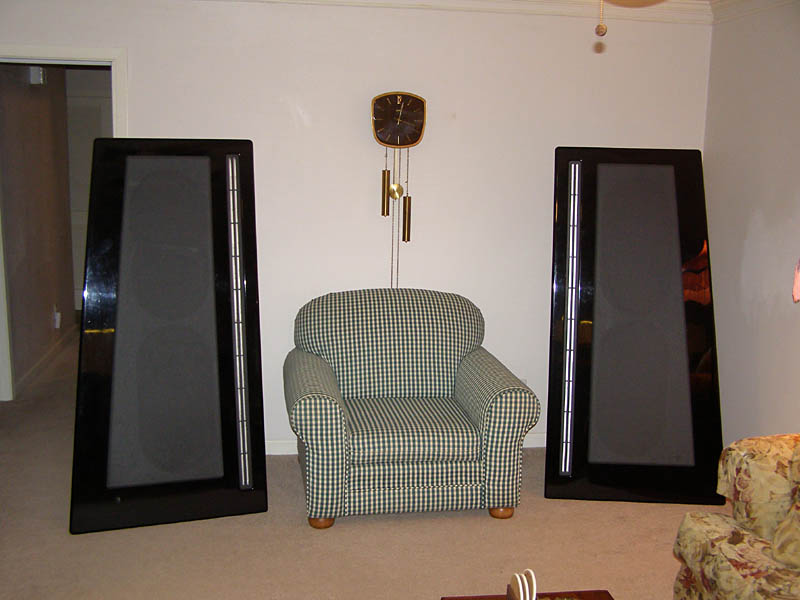
"The Clue" - ny amerikansk högtalare

Generell diskussion om hifi och områden runt hifi.

Moderator: Redaktörer

Användarvisningsbild
Jacro
 
Inlägg: 99
Blev medlem: 2009-08-15
Ort: Seattle, Washington USA

Inläggav Jacro » 2011-02-19 02:45

paa skrev:James, I have just been reading a little of what Roy Allison have to say, and he apparently tries to get "maximum and equal dispersion
from the lowest to the highest audible frequencies" (in half space).
A tractrix or kugelwellenhorn and/or a small midrange with very wide dispersion, sounds like a possible way to achieve this in the upper range, but I cannot see how this goal could be compatible with using directivety control waveguides having the standard 60 to 90 degrees coverage angles?
Do you agree with Roy Allison that full half space is the optimum dispersion for the entire sound spectrum?


paa,

It depends on the type of system architecture, boundary characteristics, and distance relationships among the closest four boundaries.

I tend to not agree with Allison, relative to the 180-degree radiation pattern being optimal, except for specialized applications, such as the Beveridge electrostatic or Bremen Egg when mounted on the sidewalls.

If I were NOT designing a dipole, I would generally prefer one of two approaches to the radiation pattern;

Either,

1) Limit a forward, monopole radiator to a maximum of 90-degrees over the full bandwidth (cross-firing in front of the listener), [[One of the ways this is accomplished through the use of a constant directivity, 90-degree waveguide combined with a proprietary type of gradient low frequency architecture]]

OR,

2) Arrange for the first four boundary distances to be cross-relational such that they are distributed and/or cross-cancelling. In the second case, the system would ideally, have a smooth, but complex transitional power response that is calibrated to match the predetermined boundary interaction.

Both are rather complex to develop, and the second approach is the basis for the operation of The Clue.

In terms of Allison’s systems, most all of them were 180-degree/half space horizontal radiators, and while they had a smooth balance and generous spaciousness, they were rather poor at focusing images, making the placement of each instrument more spatially vague than what the recording has to offer. Allison liked this type of spaciousness and vague imaging but it was not well received in America.

The exception was the less well-known Allison Model Three, which was meant to operate into a limited, 90-degree angle over the entire spectrum, and when properly set up with local absorption and an optimal room, was by far his best sounding product and an exceptional performer under ideal conditions.


- James
Founder/Director Definitive Audio
Developer of ( the clue ) for SJÖFN Hi-Fi
Owner Croft Acoustical

Användarvisningsbild
petersteindl
Der Eiermann
 
Inlägg: 41437
Blev medlem: 2007-04-17
Ort: Härnösand

Inläggav petersteindl » 2011-02-19 02:49

Laila skrev:Kanske att man skall respektera vad Jacro tidigare
har skrivit, nämligen att han helst inte vill uttala sig om
typ "prylar" som nuvarande är i produktion, ity han
själv är i "branschen" . . . :roll:


Det existerar ingen INO högtalare. Det finns ingen INOhögtalare i produktion 8) , eller?

Allt är ju på hobbybasis och i så fall existerar ingen produktion. Eller har jag förstått något felaktigt? :D Det är som jag ser det en fullkomlig omöjlighet att både ha en produktion och ha en produktion på hobbybasis.

MvH
Peter
VD Bremen Production AB + Ortho-Reality AB; Grundare av Ljudbutiken AB; Fd import av hifi; Konstruktör av LICENCE No1 D/A, Bremen No1 D/A, Forsell D/A, SMS FrameSound, Bremen 3D8 m.fl.

Användarvisningsbild
Objektivisten
Semesterfirare
 
Inlägg: 10903
Blev medlem: 2009-03-16
Ort: Tyska Bukten

Inläggav Objektivisten » 2011-02-19 02:57

---
Senast redigerad av Objektivisten 2011-02-19 22:00, redigerad totalt 1 gång.
Pålitlig, Flexibel, Robust

Användarvisningsbild
paa
Sökaren
 
Inlägg: 36047
Blev medlem: 2005-01-10

Inläggav paa » 2011-02-19 09:37

Jacro skrev:... combined with a proprietary type of gradient low frequency architecture
...
- James


Thanks James for your interest in this forum and all the well written answers.

This proprietary gradient low frequency solution, is this something you have already used in any of your speaker designs?
Would it look something like this effort by Naqref on this forum:

Lilla Hjärtat - Historien om en falnad flamma..
http://www.faktiskt.se/modules.php?name ... 372#289372


Jacro skrev:The exception was the less well-known Allison Model Three, which was meant to operate into a limited, 90-degree angle over the entire spectrum, and when properly set up with local absorption and an optimal room, was by far his best sounding product and an exceptional performer under ideal conditions.
- James

But that is a speaker designed for corner placement, isn't it?
Then we have problems with driving all room modes to the max, and maybe a "hole in the middle", don't we?
How much wall absorbents would you put around corner speakers like these?

Användarvisningsbild
JanBanan
Inaktiverad
 
Inlägg: 3593
Blev medlem: 2007-12-18
Ort: Skövde

Inläggav JanBanan » 2011-02-19 21:00

James,

You wrote in an earlier post that you have worked with Magnepan. May I ask what kind of input you provided and which model(s) you worked on?
Fd kabelforskare & professor på KTH
Konsult åt andra
Innehar ej F-skattsedel

Användarvisningsbild
Jacro
 
Inlägg: 99
Blev medlem: 2009-08-15
Ort: Seattle, Washington USA

Inläggav Jacro » 2011-02-20 05:23

JanBanan skrev:James,

You wrote in an earlier post that you have worked with Magnepan. May I ask what kind of input you provided and which model(s) you worked on?


Hi JanBanan,

My most recent work has been related to development of a new crossover topology that has been applied to the 1.7 and 3.7 models that were just introduced over the last 12 months or so.

I am basically a technical consultant that Magnepan brings into their development process to solve technical problems or provide training when their internal engineering group can’t find a solution or are having trouble optimizing particular design.

I am currently working on a new type of low frequency system.

They are very nice people and have been good friends since the mid-1970’s.

Best regards,

- James
Founder/Director Definitive Audio
Developer of ( the clue ) for SJÖFN Hi-Fi
Owner Croft Acoustical

Användarvisningsbild
Jacro
 
Inlägg: 99
Blev medlem: 2009-08-15
Ort: Seattle, Washington USA

Di-Cardioid type gradient loudspeaker

Inläggav Jacro » 2011-02-20 07:17

paa skrev:
Jacro skrev:... combined with a proprietary type of gradient low frequency architecture
...
- James


Thanks James for your interest in this forum and all the well written answers.

This proprietary gradient low frequency solution, is this something you have already used in any of your speaker designs?
Would it look something like this effort by Naqref on this forum:

Lilla Hjärtat - Historien om en falnad flamma..
http://www.faktiskt.se/modules.php?name ... 372#289372


Hi paa,

No, the design that Naqref built is not the form of gradient loudspeaker that I was referring to, but I have developed the Naqref type a number of times, since the mid-1980’s (I refer to this special form of gradient as a “Di-Cardioid” [[Hybrid of Dipole and Cardioid]]) and was granted a patent (US 7,551,062) on a number of new variations of the concept.
(I also received a trademark on it: “SoundVector™”.)

I have used it in wide bandwidth loudspeakers I have experimented with over a couple decades, but about 5 years ago I developed a narrow-band, directional backup alarm for trucks, tractors, etc. for ECCO Safety Group, using this same basic architecture. If you are interested, here are a couple links on the project;

http://www.doriandrake.com/downloads/se ... 0Story.pdf

http://www.eccolink.com/Media/WhatsNews/SVX.pdf

This structure can be very effective, even more so if one makes an active version with two monopole transducers instead of one passive dipole.

I thought I was the first to invent it back in 1985, but it turns out that Bobby Beaver at Altec Lansing had developed products based on the concept at least 10 years earlier with the Model 814A “Extenda-Voice” and was granted a patent (US 3,722,616).

http://www.lansingheritage.org/html/alt ... rs/814.htm

Later work was done in 1982 by POLAR-PRO in Finland (WO8401681) and Skip Cross in America (US 4,437,541), and also in 2001 by Noselli in Italy, EP1137318A2.

Most recently, the technique can be seen in the Gradient Helsinki 1.5 loudspeaker, used as the midrange baffle:
http://www.gradient.fi/helsinki15/

When perfectly optimized, it can provide the best combination of efficiency, and angular cancellation of any first or second order gradient arrangement, clearly outperforming a simple cardioid (but not as effective as an end-fired array).

The gradient arrangement I referred to in my previous post is a unique arrangement that I have not seen used by anyone to date and accomplishes a null-zone in a novel manner that allows a better directivity match between a 90-degree waveguide and low frequency system crossing over to the waveguide. It is an approach that was created as a reference during the development of The Clue and was used in prototyping The Clue to create a tweeter gradient that cancels the tweeter energy on axis, so that it only adds off-axis energy to the larger woofer/midrange, or full range driver (up to a desired transition frequency).

I apologize if this is more information that desired, but this type of design has great potential that has not yet been realized in commercial products, so I thought that some in your group may enjoy seeing the reference materials for the architecture that Naqref (and Ingvar?) were experimenting with.
(By the way, the post of Naqref’s stopped after only 2 pages… Was there further work and measurements reported on the experimental devices?)

Best regards,

- James
Founder/Director Definitive Audio
Developer of ( the clue ) for SJÖFN Hi-Fi
Owner Croft Acoustical

Användarvisningsbild
Jacro
 
Inlägg: 99
Blev medlem: 2009-08-15
Ort: Seattle, Washington USA

Allison Model Three

Inläggav Jacro » 2011-02-20 07:43

paa skrev:
Jacro skrev:The exception was the less well-known Allison Model Three, which was meant to operate into a limited, 90-degree angle over the entire spectrum, and when properly set up with local absorption and an optimal room, was by far his best sounding product and an exceptional performer under ideal conditions.
- James

But that is a speaker designed for corner placement, isn't it?
Then we have problems with driving all room modes to the max, and maybe a "hole in the middle", don't we?
How much wall absorbents would you put around corner speakers like these?


Yes, the Allison Model Three is designed for corner placement.

You are correct that the corner placement will activate all the low frequency room modes. It is best used with at least two additional subwoofers with diversity placement to smooth the room response in the modal frequency range. Then the bass response is both strong and smooth.
(Room modes are fine if driven properly from at least 3 diverse locations).

Also, as you surmise, the “hole in the middle” problem can come into play if the room is too wide relative to the listening distance. That is a problem with corner placement… It only works in rooms that have the correct form factor that allows optimal listener/loudspeaker relationship.

With the correct room width-to-listener distance, there is no hole in the middle and the seating position, left to right, is less critical than with most systems.

The problematic reflections are very close the loudspeaker in this case, so damping material only needs to extend from the loudspeaker about a half-meter along the front and side walls.

I redesigned the Allison Three to have the midrange and tweeter placed rearward, much more closely coupled in the corner (the speaker face was about 35 cm wide at the bottom, and less than 10 cm wide at the top, near the tweeter), with a Snell type One ramps from the tweeter edge to the front and side walls.
With this arrangement one could operate with minimal damping material because of the absence of early reflections.

Very effective, if you have the ideal room layout.

- James
Founder/Director Definitive Audio
Developer of ( the clue ) for SJÖFN Hi-Fi
Owner Croft Acoustical

Användarvisningsbild
Jacro
 
Inlägg: 99
Blev medlem: 2009-08-15
Ort: Seattle, Washington USA

?

Inläggav Jacro » 2011-02-20 19:04

Objektivisten skrev:Hell James


Objektivisten,

Curious... I'm not sure of what the significance of this statement is.

All the best,

- James
Founder/Director Definitive Audio
Developer of ( the clue ) for SJÖFN Hi-Fi
Owner Croft Acoustical

Användarvisningsbild
petersteindl
Der Eiermann
 
Inlägg: 41437
Blev medlem: 2007-04-17
Ort: Härnösand

Re: ?

Inläggav petersteindl » 2011-02-20 21:51

Jacro skrev:
Objektivisten skrev:Hell James


Objektivisten,

Curious... I'm not sure of what the significance of this statement is.

All the best,

- James


There is an o missing.
It should have been Hello James :) Quite a big difference 8)

Best Regards
Peter
VD Bremen Production AB + Ortho-Reality AB; Grundare av Ljudbutiken AB; Fd import av hifi; Konstruktör av LICENCE No1 D/A, Bremen No1 D/A, Forsell D/A, SMS FrameSound, Bremen 3D8 m.fl.

Användarvisningsbild
paa
Sökaren
 
Inlägg: 36047
Blev medlem: 2005-01-10

Re: ?

Inläggav paa » 2011-02-21 00:03

Jacro skrev:
Objektivisten skrev:Hell James


Objektivisten,

Curious... I'm not sure of what the significance of this statement is.

All the best,

- James


If we assume it's correctly spelled, the swedish expression "hell" means "hail", although that word is not yet included in google translations.
Thanks for your answers again, by the way.

Användarvisningsbild
Jacro
 
Inlägg: 99
Blev medlem: 2009-08-15
Ort: Seattle, Washington USA

Re: ?

Inläggav Jacro » 2011-02-21 04:27

petersteindl skrev:
Jacro skrev:
Objektivisten skrev:Hell James


Objektivisten,

Curious... I'm not sure of what the significance of this statement is.

All the best,

- James


There is an o missing.
It should have been Hello James :) Quite a big difference 8)

Best Regards
Peter


Thank you, Peter.

I feel better now. :)

- James
Founder/Director Definitive Audio
Developer of ( the clue ) for SJÖFN Hi-Fi
Owner Croft Acoustical

Användarvisningsbild
Jacro
 
Inlägg: 99
Blev medlem: 2009-08-15
Ort: Seattle, Washington USA

Re: ?

Inläggav Jacro » 2011-02-21 04:34

paa skrev:
Jacro skrev:
Objektivisten skrev:Hell James


Objektivisten,

Curious... I'm not sure of what the significance of this statement is.

All the best,

- James


If we assume it's correctly spelled, the swedish expression "hell" means "hail", although that word is not yet included in google translations.
Thanks for your answers again, by the way.


paa,

Hell = Hail... That is good to know.
Thank you.

And, you are very welcome on the answers. I hope they are useful.

- James
Founder/Director Definitive Audio
Developer of ( the clue ) for SJÖFN Hi-Fi
Owner Croft Acoustical

Användarvisningsbild
Objektivisten
Semesterfirare
 
Inlägg: 10903
Blev medlem: 2009-03-16
Ort: Tyska Bukten

Inläggav Objektivisten » 2011-02-21 10:52

8O Holy macaroni, the significance of my 'statement' is zero (maybe below) James. Can we please go back to the real substance in this thread, your eminent inputs and answers. :) Regards
Pålitlig, Flexibel, Robust

Användarvisningsbild
JanBanan
Inaktiverad
 
Inlägg: 3593
Blev medlem: 2007-12-18
Ort: Skövde

Inläggav JanBanan » 2011-02-21 11:05

Jacro skrev:I am currently working on a new type of low frequency system.


Hell James,

This sounds exciting! Is this something you can elaborate on?
Fd kabelforskare & professor på KTH
Konsult åt andra
Innehar ej F-skattsedel

Användarvisningsbild
KarlXII
Dussinmänniska
 
Inlägg: 28546
Blev medlem: 2007-02-17
Ort: Himlafiket

Inläggav KarlXII » 2011-02-21 11:40

JanBanan, sometimes your particular sense of humour in combination with that avatar (which probably is a display of it) makes for a very ambiguous context.
T H E. G O O S E B U M P. F A C T O R

Användarvisningsbild
petersteindl
Der Eiermann
 
Inlägg: 41437
Blev medlem: 2007-04-17
Ort: Härnösand

Re: ?

Inläggav petersteindl » 2011-02-21 13:22

Jacro skrev:
petersteindl skrev:
Jacro skrev:
Objektivisten skrev:Hell James


Objektivisten,

Curious... I'm not sure of what the significance of this statement is.

All the best,

- James


There is an o missing.
It should have been Hello James :) Quite a big difference 8)

Best Regards
Peter


Thank you, Peter.

I feel better now. :)

- James


Very good :)

remember, we usually don't bite on this forum but sometimes we bark :lol: :) and sometimes we have a very weird humor :) not only janbanan.

I will introduce myself a little bit better later on. Take care.

Best regards
Peter
VD Bremen Production AB + Ortho-Reality AB; Grundare av Ljudbutiken AB; Fd import av hifi; Konstruktör av LICENCE No1 D/A, Bremen No1 D/A, Forsell D/A, SMS FrameSound, Bremen 3D8 m.fl.

Användarvisningsbild
Stereotypen
 
Inlägg: 877
Blev medlem: 2004-03-29
Ort: Karlstad

Inläggav Stereotypen » 2011-02-21 14:29

Jacro:
It would be very interesting for me to hear what you think about the Audio Artistry Beethoven system. This is the speaker that I use myself. Here in Sweden there is a very limited amount of people that own this speaker but I guess that in the US they are more common. Have you heard them? What is your impression/oppinion of them? What is your oppinion of dipole bass in general?
The speakers are not manufactured any more so I guess it would be ok for you to comment on them. :)

Användarvisningsbild
Jacro
 
Inlägg: 99
Blev medlem: 2009-08-15
Ort: Seattle, Washington USA

Audio Artistry Beethoven and Dipole Woofer Systems

Inläggav Jacro » 2011-02-24 10:12

Stereotypen skrev:Jacro:
It would be very interesting for me to hear what you think about the Audio Artistry Beethoven system. This is the speaker that I use myself. Here in Sweden there is a very limited amount of people that own this speaker but I guess that in the US they are more common. Have you heard them? What is your impression/oppinion of them? What is your oppinion of dipole bass in general?
The speakers are not manufactured any more so I guess it would be ok for you to comment on them. :)


My apologies to everyone that has asked questions that I have not yet answered. I am particularly busy this week but will try to get back with more follow up next week.

I'll provide some short answers to a few questions and follow up later with more info.

Stereotypen,

Yes, I heard the Beethoven a few times back in 1998.

I thought that they could be made to perform quite well if they were in a large venue.

With the Linkwitz designs there are still some of the issues associated with center-symmetrical dipoles when they are constructed with point source drivers. This arrangement usually causes a significant dip in the midrange combined with some comb filtering ripple above the first dip frequency which is associated with the symmetrical 1-wavelength acoustical back-to-front path. This issue has been minimized with careful crossover work, but it is difficult to eliminate completely.

With dipoles, it is most often better to either use a full-baffle-sized diaphragm, such as with electrostatics or Magneplanars, OR, horizontally offset the transducer on the mounting baffle, to create diversity paths for the back-to-front output.

In terms of dipole bass, I believe it can be a very effective, at least when used above the lowest modal frequencies. Below the modal range, to maximize room gain, closed-form enclosures tend to be superior.

I've done quite a bit of work in this regard, in that I developed the first effective commercially viable cone based dipole woofer system, for use in the Carver Amazing Loudspeaker (with a Large Area Full Range Ribbon we developed for use above 100 Hz) in the early 1980's. Even though we were told it couldn't be done, we were able to achieve -3dB at 19 Hz by incorporating novel 12" woofers with 1.5" peak-to-peak linear excursion capability and a Qts of 3.4, mounted on a variable width baffle.

If anyone is interested, here is a picture of the system I developed...

http://www.soundsgoodtomehouston.com/carver/alspair.jpg

and

the European patent...

http://v3.espacenet.com/publicationDeta ... cale=en_EP

The folded version of a dipole woofer, such as used in the Beethovan subwoofer, can perform the bass function quite well, but there are some anomalies above the pass band that can make for more difficult crossover transitions to the upper range system than a simple flat/open dipole woofer system, but if miniaturization of the dipole is important, the folded type can reduce the apparent size effectively.

I don't mean to sound overly critical of the Beethoven. It is a system that has a lot of potential and I would very much like to see it developed further to reach that potential.

More later...

Cheers,

- James
Founder/Director Definitive Audio
Developer of ( the clue ) for SJÖFN Hi-Fi
Owner Croft Acoustical

Användarvisningsbild
Stereotypen
 
Inlägg: 877
Blev medlem: 2004-03-29
Ort: Karlstad

Inläggav Stereotypen » 2011-02-24 14:45

Thank you for your answer James! :)

Användarvisningsbild
paa
Sökaren
 
Inlägg: 36047
Blev medlem: 2005-01-10

Inläggav paa » 2011-02-24 22:09

Jacro skrev:...
OR,

2) Arrange for the first four boundary distances to be cross-relational such that they are distributed and/or cross-cancelling. In the second case, the system would ideally, have a smooth, but complex transitional power response that is calibrated to match the predetermined boundary interaction.

Both are rather complex to develop, and the second approach is the basis for the operation of The Clue.
...
- James


How can this be made to work for different room sizes, and different listening distances, things that also would demand different distances between the speakers?
Could this cross-relational and cross-cancelling function be simulated in some known software?

Användarvisningsbild
Naqref
Saknad grundare, †2014
 
Inlägg: 27893
Blev medlem: 2003-03-23
Ort: Krischansta

Re: Di-Cardioid type gradient loudspeaker

Inläggav Naqref » 2011-02-25 15:41

Jacro skrev:(By the way, the post of Naqref’s stopped after only 2 pages… Was there further work and measurements reported on the experimental devices?)


Hello James,

Finally I had som time (and focus) to read the whole thread and I'm very impressed as many others.

Regarding My little sweetheart it's scrapped but I'll think I have some measurement of it somewhere in one of my computers. Perhaps I'll find it and then I'll post some information here (and in the original thread).

The first ambience-module with the principle was made around 1995. A couple of years later I built the one on the pictures. I was still a poor student at the time so there was actually no money to develop the principle then. And then I found other things more promising.

I found your patent:
http://www.freepatentsonline.com/7551062.pdf
Impressive. I'll think the right way to go ist to use multiple active units just as you say. Passive damping of the sound from the back of the unit is to test intensive to get right.

I am like you intrested in what I call wall integrated speakers. It should perhaps be altered to external wall integrated speakers (EWI) or something like that to avoid beeing misstaken for in-wall-speakers. But anyhow. I'm the designer of Larsen speakers (it's a follow up of Carlsson). Two major problems with ewi-speakers is the perception of depth and excitment of roomresonances I'll think. The problem with depth is that the mind has problems to project auditory sources beyond the visual boundaries. The eye's override of other senses is making it harder to imagine a sound stage beyond the front wall. Do you think this is a big problem and if so what else is there to do about it other than removal of visual clues or to give additional visual clues to aid the sound stage?

The second problem (actually it's really a problem with almost every type of speaker), what is your preffered method of dealing with that? Acoustical lf-absorbers, parametrical eq or perhaps using multiple sound sources to counter act the resonanses?

Send my regards to Lars Erickson. :)
Audiodesigner åt en del. Larsen, Holographic Audio etc.
CEO och huvudägare i Acoustic Landscape R&D AB.
CTO / R&D Manager och delägare i Acoustic Illusion AB.

Användarvisningsbild
paa
Sökaren
 
Inlägg: 36047
Blev medlem: 2005-01-10

Inläggav paa » 2011-02-25 16:16

I found the Bremen egg spekers to present a somewhat larger soundstage depthwise than sidewise when they were displayed at the Stockholm High End Show a couple of weeks ago. (With front speaker and proprietary matrix center decoding.)
Perhaps that was because they were placed on the sidewalls, positioned a bit back from the front wall, and the room was longer than wide, could that have been mainly a visible illusion too?

Användarvisningsbild
petersteindl
Der Eiermann
 
Inlägg: 41437
Blev medlem: 2007-04-17
Ort: Härnösand

Inläggav petersteindl » 2011-02-25 17:00

paa skrev:I found the Bremen egg spekers to present a somewhat larger soundstage depthwise than sidewise when they were displayed at the Stockholm High End Show a couple of weeks ago. (With front speaker and proprietary matrix center decoding.)
Perhaps that was because they were placed on the sidewalls, positioned a bit back from the front wall, and the room was longer than wide, could that have been mainly a visible illusion too?


That has primarily to do with the angle difference between the center and the side speakers. If I play the loudspeakers shifted so that the center is on the long wall and the Bremen eggspeakers on the short side walls, then it would have been different.

That was the way in which I originally intended to demonstrate my loudspeakers, but at the end just before moving into the room they said at Sheraton that the desk in the rooms could not be taken out and the desk is rather big, so I decided to do the demonstration as I did.

But the visual information is also important.

Best Regards
Peter Steindl
VD Bremen Production AB + Ortho-Reality AB; Grundare av Ljudbutiken AB; Fd import av hifi; Konstruktör av LICENCE No1 D/A, Bremen No1 D/A, Forsell D/A, SMS FrameSound, Bremen 3D8 m.fl.

Användarvisningsbild
Jacro
 
Inlägg: 99
Blev medlem: 2009-08-15
Ort: Seattle, Washington USA

Part 2 answer to Objectivisten

Inläggav Jacro » 2011-02-28 02:00

Objektivisten skrev:Hi James, welcome to the forum, what do You think is the secret about tubes and that they almost always sounding more pleasant and true to the ears? And do we really need all that watts, low powered amps seems to gain in transparent sound, may be construction simplicity or cost effectiveness?


Objektivisten skrev:8O Holy macaroni, the significance of my 'statement' is zero (maybe below) James. Can we please go back to the real substance in this thread, your eminent inputs and answers. :) Regards


I agree.

In terms of our previous discussion on the causes of sonic differences between power amplifiers, in “Part One” discussed a few of the issues relating to the significance of overload characteristics during normal use of power amplifiers.

As a point of interest, these portions of the total research program that started in the 1970’s and were repeated in the early 1990’s as part of the development program for a new line of amplifiers that were produced in the mid and late 1990’s.

PART TWO: (A brief overview of the impact of wide band output impedance)

Next, in our research on this topic, we uncovered the effects of power amplifier output impedance and the interface with the loudspeaker load.

Output impedance is often referred to as damping factor relative to an 8-ohm load, but as we know, there are is not a single loudspeaker on the market that actually exhibits an 8-ohm, zero phase angle, load over the useful frequency range of the loudspeaker.

Also, damping factor is most often referred to as a low frequency phenomenon, with most amplifier specifications using 100 Hz as a reference frequency, when, in actuality, it is at least as important at high frequencies as it is at low frequencies. Unfortunately, most power amplifiers do not specify their high frequency damping factors… for the reason that most of them are substantially worse than they are at low frequencies.

(NOTE: There can also be dynamic, or non-linear output impedances in power amplifiers, and dynamic, non-linear input impedances in loudspeakers, but for this discussion, we will limit our observations to linear, small signal damping factor/output impedances and input impedances.)

Essentially, as one raises the output impedance (or lowers the damping factor) in a power amplifier, the amplitude error due to the impedance interface can cause the frequency response to take on the shape of the impedance curve more and more as the output impedance is higher.

Nearly all power amplifiers incorporate reactive components between the output stage and the output terminals. Most power amplifiers vary the amount of negative feedback vs. frequency, such that the output impedance increases with frequency due to the reduced feedback and output inductance.

After completing our studies in amplifier overload characteristics, we used the amplifiers in a manner that guaranteed that they operated below overload, and also kept them below the levels that would drive the loudspeaker in test, into nonlinearity, so as to eliminate those two variables in the device under test, as we moved on to isolate remaining parameters that affected sound quality in power amplifiers.

Even though we were operating both the power amplifiers and loudspeakers below and known nonlinear audible thresholds we were still detecting coloration differences between power amplifiers, with greater differences being exposed with some loudspeakers more than with other loudspeakers.

A first causal parameter, that we were able to isolate, was linear amplitude distortion due to the interaction of the amplifier and the loudspeaker impedances.

While there were audible errors in the lower and middle frequencies in certain tube amplifiers and a few specialized, low feedback solid-state amplifiers, (due to higher output impedances - poor damping factor - at low frequencies), this was not too surprising, as this issue had been reported previously, at least anecdotally, if not by way of rigorous controlled testing.

What was more interesting, were the number of amplifier loudspeaker combinations that generated high frequency coloration, due to the amplifier output impedance, at high frequencies, causing high frequency amplitude errors.

Many amplifiers have substantially worse damping factors at the highest frequencies, relative to the lower frequencies (below 1 kHz) and due to phase angle and impedance variations, exhibited in the loudspeaker, substantial response errors were observed. While most varied less than 1.2 dB, in some cases we found high-frequency response variations, between 5 kHz and 20 kHz, of over 2.5 dB!

As one can imagine, these levels of amplitude error, while in many cases subtle, are clearly audible, and repeatable with double blind testing.

It is interesting that there are still no industry standards for minimum impedance and phase angle. (THX and a few private parties have their own guidelines, but that is not recognized or enforced in most realms of audio).

It is easy for loudspeaker designers to be abusive in terms of impedance curves, as it can often serve their purposes to allow the impedance to fall to very low levels in exchange for some other advantage in performance, such as amplitude response.

Recently I was evaluating a new loudspeaker for a company, and I noticed that the impedance curve dipped to well below 2 Ohms at 285 Hz. They had done this because they had a dip in the amplitude response at 300 Hz and the only way to boost the response to flat in the passive-crossover, was to create an under-damped alignment in the high pass filter. The power spectrum in music program tends to be divided approximately equally above and below 270 Hz, and so the greater power demands are right were this loudspeaker had it’s lowest impedance, creating unusual current demands from the power amplifier.

They get the response they wanted and passed the impedance interface problem onto the amplifier designer.

Another popular loudspeaker, from the 1980’s, had a 0.9Ω impedance (and a large phase angle) at about 3.7 kHz. This caused a myriad of problems with amplifier interactions.

Amplifiers with any significant output impedance relative to the input impedance of the loudspeaker don’t operate any longer as an ideal voltage source, and can easily exhibit sonic errors because of this issue.

Depending on the set of conditions, audible problems can be caused by current limiting or by linear amplitude errors, or both.

As an aside, there is a story about our test procedure you may find interesting;

To isolate the audible effects during our testing process we used a number of approaches, such as straight wire bypass tests and double blind testing.

Some folks believe that results derived from blind testing is not valid, particularly when there is a null result.

During the time of our research, and still today, many audiophiles reject double blind testing as a procedure that causes stress that “interferes” with their psychological ability to make accurate assessments.

During our research project, we decided to test this notion. We had two amplifiers that both performed very well, but one sold for seven times more than the other one and was known as a very prestigious amplifier, having received rave reviews. We had two groups of audiophiles that claimed that they could always easily hear the difference between the two amplifiers, speaking rather critically of the lower cost unit, and glowingly of the higher cost amp.

During out double blind tests, each of them failed to consistently pick their favorite amplifier. So, we told them to take the two amplifiers, and listen to them under whatever test conditions they felt they were most comfortable, and to keep notes on what they perceived and which they preferred. We had approximately 20 people in two separate groups involved, all of them diehard audiophiles and critical of DBX testing.

Before we gave them the two amplifiers, we made one change. We exchanged the internal circuitry, so that the “cheap” amplifier was in the “expensive” chassis, and the “expensive” amp was in the “cheap” amp chassis.

We gave them the amplifiers and after they all had a chance to test them in the manner they were most comfortable, we retrieved the amplifiers and their written test results.

It may or may not be a surprise to you, that every one of them chose the amplifier in the expensive amplifier’s chassis as the one that sounded best, and had pages and pages of notes expressing their preference, and also expressing how easy it was to hear the difference and how the difference was quite large.

I learned two things from this experiment: 1) uncontrolled tests, that are not double blind, will produce random or erroneous results, and 2) even when shown this kind of evidence, it is not convincing for most of those that have already made up their mind that double blind testing doesn’t work.

So, I don’t think I made any converts, but it was an illuminating experiment.

Just to be clear, I am not saying that one cannot detect real differences between devices under test without a double blind test. I am only saying that it is important to verify any differences by way of double blind testing.

Actually, we have often been able to identify actual differences with double blind testing that are often not noticed in casual testing… but more on that another time.

Anyhow, so far we have covered two of the elements that can be of significance in explaining audible differences in power amplifiers, both of which are often overlooked;

- Audible clipping characteristics due to partial overload, and

- Wideband damping factor (Output Impedance) interface and interaction with the loudspeaker load

While there are some other issues that can affect amplifier sound quality, we can explain much of your original question with these two forms of distortion.

I can discuss further the specifics of these two forms and how they related to your original inquiry, and we can discuss other issues relative to power amplifiers in the future, if you wish, but I am delinquent on quite a few loudspeaker questions that I should answer first.

All the best,

- James

Founder/Director Definitive Audio
Developer of ( the clue ) for SJÖFN Hi-Fi
Owner Croft Acoustical

Användarvisningsbild
Vinylcalle
 
Inlägg: 3089
Blev medlem: 2008-12-24
Ort: Lund

Inläggav Vinylcalle » 2011-02-28 03:13

I have been reading this thread from the begining and want to say thanks to James for all the time he puts into giving us some great information. Especially the last answer about damping factor and amplifier research was great.

Well since I have got the opportunity I might as well ask you a question James.

Whats your view on vintage-hifi? I often get the feeling that there haven´t been much significant development since the golden days in the late 70s early 80s. If their is one thing that has changed its perhaps that there is more badly constructed equipment on the market today.
Some of my audiophile friends doesn´t agree, they´re basicly the ones who don´t believe in blind tests either. :D

Have you ever come across some of the old Denon totl equipment like poa3000,poa1500 and pma790? I think their great and some of the best amps I ever heard.

Best Regards Carl
VD och ägare
www.rehifi.se

Användarvisningsbild
petersteindl
Der Eiermann
 
Inlägg: 41437
Blev medlem: 2007-04-17
Ort: Härnösand

Inläggav petersteindl » 2011-02-28 03:31

Hi James, are you watching? :)

rgds
Peter
VD Bremen Production AB + Ortho-Reality AB; Grundare av Ljudbutiken AB; Fd import av hifi; Konstruktör av LICENCE No1 D/A, Bremen No1 D/A, Forsell D/A, SMS FrameSound, Bremen 3D8 m.fl.

Användarvisningsbild
Jacro
 
Inlägg: 99
Blev medlem: 2009-08-15
Ort: Seattle, Washington USA

Inläggav Jacro » 2011-02-28 04:58

sportbilsentusiasten skrev:Thanks for the list Jacro!
I'm also a fan of QUAD, lovely speakers :D


Can you please elaborate on pi60's "promising characteristics"?
Jacro skrev: Here are a few currently available loudspeakers that, in my opinion, have promising characteristics.

AudioKinesis Dream Maker
Emerald Physics CS2.3
Ino Audio pi60


The pi60 is a very organic and well integrated device with many good qualities.

But what impresses me most about the pi60, is not just its ability to perform well with excellent program material, but the unique capability to also extract a surprisingly lifelike presentation from many rather mediocre recordings.

That is not a trivial accomplishment.

- James
Founder/Director Definitive Audio
Developer of ( the clue ) for SJÖFN Hi-Fi
Owner Croft Acoustical

Användarvisningsbild
Jacro
 
Inlägg: 99
Blev medlem: 2009-08-15
Ort: Seattle, Washington USA

Inläggav Jacro » 2011-02-28 05:11

petersteindl skrev:Hi James, are you watching? :)

rgds
Peter


Yes, I am.
Founder/Director Definitive Audio
Developer of ( the clue ) for SJÖFN Hi-Fi
Owner Croft Acoustical

Användarvisningsbild
Jacro
 
Inlägg: 99
Blev medlem: 2009-08-15
Ort: Seattle, Washington USA

Inläggav Jacro » 2011-02-28 09:09

Vinylcalle skrev:I have been reading this thread from the begining and want to say thanks to James for all the time he puts into giving us some great information. Especially the last answer about damping factor and amplifier research was great.

Well since I have got the opportunity I might as well ask you a question James.

Whats your view on vintage-hifi? I often get the feeling that there haven´t been much significant development since the golden days in the late 70s early 80s. If their is one thing that has changed its perhaps that there is more badly constructed equipment on the market today.
Some of my audiophile friends doesn´t agree, they´re basicly the ones who don´t believe in blind tests either. :D

Have you ever come across some of the old Denon totl equipment like poa3000,poa1500 and pma790? I think their great and some of the best amps I ever heard.

Best Regards Carl


Hi Vinylcalle,

I am fond of many of the vintage units. The Denon POA-3000 was one of the better implementations of the Dynamic Class-A circuits that were being developed at that time (around 1979), and it was a beautiful package.

The PMA-790 Integrated utilized a variation on the Quad Current Dumping Architecture, that also worked quite well. I never had a chance to try the POA-1500.

I used to put on a vintage demonstration in Seattle every 5 years to show how well a pre-1970 system can be made to perform.

A double or triple set of Quad ESL's, with Marantz 9 power amplifiers, Marantz 7c pre-amp, and playing Master Tapes as source material was always good for illustrating how little progress has been made over the years.

- James
Founder/Director Definitive Audio
Developer of ( the clue ) for SJÖFN Hi-Fi
Owner Croft Acoustical

FöregåendeNästa

Återgå till Generellt om hifi


Vilka är online

Användare som besöker denna kategori: ajna och 18 gäster