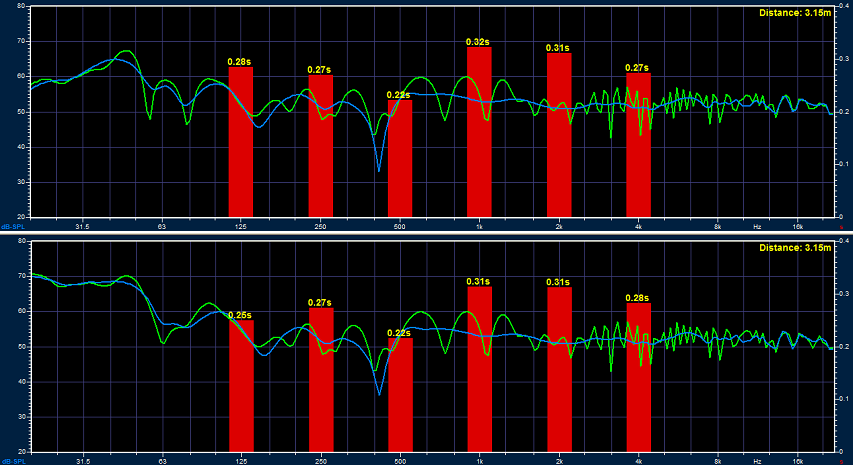

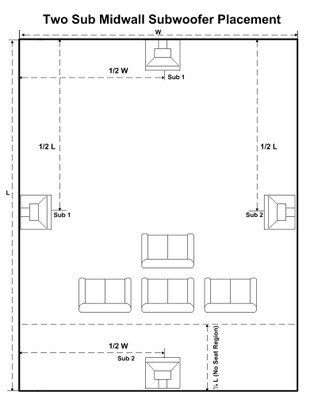
Obviously, wall midpoint locations result in optimum room response, based on the std anyway. Not surprisingly, symmetrical configurations seem to work better than nonsymmetrical ones. Four subwoofers results in the most symmetrical configuration and the best results, but with significantly less (normalized) low frequency output than two subs.
Här kommer litet vetenskapligt förankrat tips hur du "placerar" 4 subwoofers utan stora ombyggnationer eller en massa dämpmaterial. Utan mätningar släcks de flesta störande rumsresonanserna och ger nästan lika bra effekt som av 5000 subwoofers. Lyssningsarean blir relativt stor men ett krav som inte får missas är att lyssningsarean måste vara minst 1/4 längd/bredd från närmaste vägg (se bild). Värt att pröva är en nästan lika bra placering med högtalarna i hörnen. Ljudtrycket ökar markant och/eller kan du använda mindre subbasar.
Using very large numbers of subwoofers would result in cancellation of room modes. For practical numbers of subwoofers, there appears to be no obvious correlation. When you consider the additional expense of using more subwoofers, there is certainly no justification for using more than four. To the contrary, it was observed that the LF factor actually went down for larger numbers of subwoofers
Subwoofers: Optimum Number and Locations by Todd Welti Research Acoustician, Harman International Industries, Inc. twelti@harman.com
https://www.harman.com/sites/default/fi ... ltsubs.pdf
References
[1] S. Olive, P. Schuck, S. Sally, and M. Bonneville, “The Effects of Loudspeaker Placement on Listeners’ Preference Ratings”, J. Audio Eng. Soc ., vol. 42, pp. 651-669 , (1994 Aug).
[2] A. R. Groh, “High Fidelity Sound System Equalization by Analysis of Standing Waves”, J. Audio Eng. Soc ., vol. 22, pp. 795-799 (1974 Dec).
[3] R. F. Allison and R. Berkovitz, “The Sound Field in Home Listening Rooms”, J. Audio Eng. Soc ., vol. 24, pp. 14-19 (1975 Dec).
[4] M. Kleiner and H. Lahti, “Computer Prediction of Low Frequency SPL Variations in Rooms as a Function of Loudspeaker Placement”, J. Audio Eng. Soc ., preprint 3577, (1993 Mar).
[5] J. A. Pedersen, K. Hermansen and P. Rubak, “The Distribution of the Low Frequency Sound Field and its Relation to Room Equalization”, J. Audio Eng. Soc ., preprint 3852, (1994 Feb).
[6] E. Benjamin and B. Gannon, “The Effect of Room Acoustics on Subwoofer Performance and Level Setting”, J. Audio Eng. Soc ., preprint 5232, (2000 Sept).
[7] N. Zacharov, S. Bech, and D. Meares, “The Use of Subwoofers in the Context of Surround Sound Program Reproduction”, J. Audio Eng. Soc ., vol. 46, pp. 276-287 (1998 April).
[8] S. J. Elliott, “Practical Implementation of Low-Frequency Equalization Using Adaptive Digital Filters”,
[9] D. Griesinger, “Multichannel Sound Systems and Their Interaction with the Room”, J. Audio Eng. Soc . 15th International Conference : Audio, Acoustics & Small Spaces , Paper 15, pp. 159-173 (1998 Sept).
[10] P. M. Morse, Vibration and Sound , (Mcgraw Hill, NY, 1948), p. 313, 418.
[11] P. M. Morse and K. U. Ingard, Theoretical Acoustics , (Mcgraw Hill, NY, 1968), p. 576-598.
[12] J. Borwick (ed.), Loudspeaker and Headphone Handbook , (Mcgraw Hill, NY, 1968), ch. 7.
[13] R. Walker, “ L o w - Fr e q u e n c y R o o m R e s p o n s e s : Pa r t 2 – Ca lc u l a t io n M e t h o d s a n d E x p e r i m e n t a l Results” , BBC Research Department Report BBC RD 1992/9, 1992, Appendix.
[14] Room Optimizer, RPG Diffuser Systems, Inc. 651-C Commerce Dr. , Upper Marlboro, MD.
[15] CARA (Computer Aided Room Acoustics), ELAC Technische Software GmbH, Rendsburger Landstrasse 215.
[16] F. Asano, D. C. Swanson, “Sound Equalization in Enclosures Using Modal Reconstruction”, J. Acoust. Soc. Am ., 98 (4), pp. 2062-2069 , (1995 Oct).
[17] S.J. Elliott, P. A. Nelson, “Multiple-Point Equalization in a Room
JM